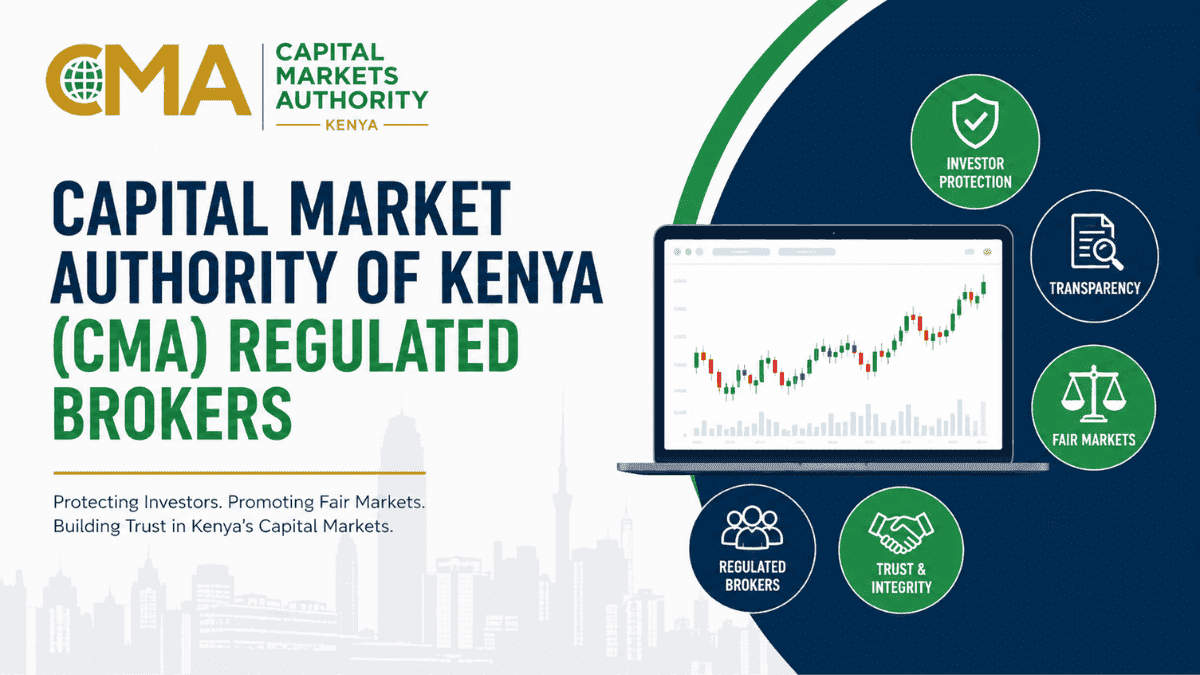
The Capital Market Authority of Kenya (CMA) regulates brokers, who play a critical role in protecting investors and maintaining trust in Kenya’s financial markets. Whether you are interested in trading shares listed on the Nairobi Securities Exchange (NSE), investing in bonds, participating in collective investment schemes, or accessing other regulated financial products, choosing a CMA-regulated broker provides an important layer of protection.
For Kenyan investors, regulation is not just a legal requirement—it’s a safeguard against fraud, market abuse, and unethical business practices. Understanding how the CMA operates, what protections it offers, and how to identify licensed brokers can help you make more informed investment decisions.

What Is the Capital Market Authority of Kenya (CMA)?
The Capital Market Authority (CMA) is Kenya’s primary regulator of capital markets. Established under the Capital Markets Act, the authority oversees market participants and ensures that capital markets operate fairly, transparently, and efficiently.
The CMA’s responsibilities extend across multiple areas of the investment industry. It licenses and supervises market intermediaries, develops regulatory frameworks, protects investors, and promotes market integrity.
The authority works closely with other financial regulators in Kenya to strengthen the country’s financial ecosystem and improve investor confidence.
Why Was the CMA Created?
The Kenyan capital market has grown significantly over the years. As more investors entered the market and new financial products emerged, there was a need for a dedicated regulator to oversee activities and reduce risks.
The CMA was created to:
- Protect investors from unfair practices
- Promote fair and efficient markets
- Encourage capital formation
- Maintain confidence in Kenya’s financial system
- Support the growth of the investment industry
Without regulation, investors would face higher risks of fraud, mismanagement, and market manipulation.
What Are CMA Regulated Brokers?
CMA-regulated brokers are financial firms authorized by the Capital Market Authority to offer specific investment services in Kenya.
These brokers operate under strict regulatory standards and are subject to ongoing supervision. They must comply with rules regarding capital adequacy, client fund protection, reporting requirements, governance, and ethical conduct.
A broker cannot legally offer regulated capital market services in Kenya without obtaining the appropriate CMA license.
Types of CMA-Licensed Market Intermediaries
The CMA licenses several categories of financial institutions.
These may include:
- Stockbrokers
- Investment banks
- Investment advisers
- Fund managers
- Collective investment scheme managers
- Real Estate Investment Trust (REIT) managers
- Online forex brokers operating under Kenyan regulations
- Authorized securities dealers
Each category has its own regulatory requirements depending on the services offered.
Why Choosing a CMA Regulated Broker Matters
Regulation is often overlooked by new investors who focus mainly on fees, platforms, or potential returns. Yet regulation may be the single most important factor when choosing a broker.
A licensed broker operates within a framework designed to protect clients and maintain market stability.
Investor Protection
One of the biggest benefits of choosing a CMA-regulated broker is investor protection.
Licensed firms must follow strict operational standards that reduce the risk of misconduct. The regulator monitors their activities and can take enforcement action when violations occur.
If a dispute arises, investors have access to established complaint resolution mechanisms.
Transparency and Disclosure
Regulated brokers must provide clear information regarding:
- Fees and commissions
- Investment risks
- Products and services
- Terms and conditions
- Regulatory status
This transparency helps investors make informed decisions rather than relying on marketing claims alone.
Financial Stability Requirements
CMA-regulated firms must maintain minimum capital requirements.
These requirements help ensure that brokers have sufficient financial resources to operate responsibly and meet their obligations to clients.
While regulation cannot eliminate all risks, it significantly reduces the likelihood of dealing with an undercapitalized or unstable firm.
CMA Regulation of Online Forex Brokers in Kenya
The online forex trading industry has grown rapidly in Kenya. Thousands of traders now participate in global currency markets through electronic trading platforms.
Recognizing this growth, the CMA introduced a regulatory framework specifically for online foreign exchange brokers.
This framework established licensing requirements designed to improve transparency and protect retail traders.
Benefits of Trading With a CMA-Licensed Forex Broker
A CMA-regulated forex broker offers several advantages compared to an unlicensed broker.
These benefits may include:
- Local regulatory oversight
- Stronger investor protection
- Compliance with Kenyan laws
- Greater transparency
- Formal complaint procedures
- Ongoing supervision by the regulator
Many traders feel more comfortable working with firms that are accountable to a local regulatory authority.
Risks of Unregulated Forex Brokers
Not every broker targeting Kenyan traders is supervised by the CMA.
Some offshore brokers may provide legitimate services, while others operate with little or no oversight. This can create risks related to fund security, withdrawal issues, pricing practices, and dispute resolution.
Before opening an account, investors should always verify a broker’s regulatory status.
How the CMA Protects Investors
The CMA’s investor protection role extends beyond licensing.
The authority actively monitors market participants and enforces regulations intended to maintain confidence in Kenya’s financial system.
Licensing and Approval
Every licensed broker must undergo a thorough approval process.
This process evaluates the firm’s:
- Ownership structure
- Financial resources
- Management competence
- Compliance systems
- Operational capabilities
Licensing helps filter out businesses that do not meet regulatory standards.
Ongoing Supervision
Approval is only the beginning.
Licensed firms are subject to continuous oversight through audits, reporting requirements, inspections, and compliance reviews.
This ongoing supervision helps identify potential issues before they become serious problems.
Enforcement Actions
When a regulated entity violates rules, the CMA has the authority to impose sanctions.
Depending on the severity of the breach, actions may include:
- Fines
- Suspensions
- Restrictions
- License revocation
- Public warnings
These enforcement powers help maintain accountability across the industry.
How to Verify a CMA Regulated Broker
Before depositing funds with any broker, it is essential to confirm that the company holds a valid license.
Many fraudulent firms falsely claim regulatory approval, making independent verification important.
Check the CMA Register
The CMA maintains records of licensed entities.
Investors should search the regulator’s official register to confirm:
- The firm’s legal name
- License status
- Authorized activities
- Regulatory standing
Always verify information directly through official sources rather than relying solely on broker websites.
Review the Broker’s Regulatory Disclosures
Legitimate brokers typically provide regulatory details on their websites.
These disclosures should clearly state:
- License number
- Licensed entity name
- Regulatory authority
- Contact information
Any lack of transparency should be treated as a warning sign.
Watch for Red Flags
Certain warning signs may indicate potential problems.
Examples include:
- Guaranteed profits
- Pressure to deposit immediately
- Unrealistic return promises
- Lack of regulatory information
- Poor customer support
- Difficulty withdrawing funds
No regulated broker can legitimately guarantee investment returns.
Features to Look for in a CMA Regulated Broker
Regulation should be your starting point, but not your only consideration.
Different brokers offer different strengths depending on your investment goals.
Trading Platforms
A reliable platform can significantly improve the trading experience.
Look for platforms that offer:
- Stable performance
- Fast execution
- Mobile access
- Risk management tools
- Market analysis features
Ease of use is especially important for beginners.
Fees and Costs
Every broker charges fees in one form or another.
Common costs include:
- Trading commissions
- Spreads
- Account maintenance fees
- Withdrawal charges
- Inactivity fees
Understanding the full cost structure can help prevent unpleasant surprises later.
Customer Support
Good customer service becomes particularly valuable during periods of market volatility.
A responsive support team can help resolve issues quickly and improve the overall investment experience.
Educational Resources
Many brokers now provide educational content designed to help investors improve their knowledge.
These resources may include:
- Webinars
- Tutorials
- Trading guides
- Market analysis
- Research reports
Education is especially useful for new investors entering financial markets.
CMA Regulated Brokers vs Offshore Brokers
Investors often compare local regulation with offshore regulation when selecting a broker.
Each option has advantages and disadvantages.
Advantages of CMA-Regulated Brokers
Local regulation offers several benefits.
These include:
- Kenyan legal protections
- Easier dispute resolution
- Local regulatory oversight
- Greater accountability
- Familiar regulatory environment
For many investors, these factors provide additional peace of mind.
Advantages of Some Offshore Brokers
Certain offshore brokers may offer:
- Wider product selection
- Higher leverage
- More account types
- Global market access
However, investors should carefully assess the offshore regulator’s quality before opening an account.
Which Option Is Better?
There is no universal answer.
A trader focused on regulatory protection may prioritize CMA regulation. Another investor seeking access to international products may choose a broker regulated in multiple jurisdictions.
The key is understanding the trade-offs and ensuring that any chosen broker operates under credible regulatory oversight.
Common Mistakes Investors Make When Choosing Brokers
Many investors focus on the wrong factors when selecting a broker.
Avoiding these mistakes can help improve your investment experience.
Chasing Bonuses
Promotional offers can be attractive, but they should never be the primary reason for choosing a broker.
Regulation, reliability, and service quality are far more important.
Ignoring Regulatory Status
Some investors assume that every online broker is properly regulated.
This assumption can be costly if problems arise later.
Always verify licensing independently.
Overlooking Costs
Low advertised spreads may not tell the whole story.
Investors should review all potential charges before opening an account.
Focusing Only on Leverage
Higher leverage increases both potential profits and potential losses.
A broker offering extremely high leverage is not necessarily the better choice.
The Future of CMA Regulation in Kenya
Kenya’s capital markets continue to evolve as technology changes the way people invest and trade.
The CMA has increasingly focused on innovation, digital finance, fintech development, and investor education.
As participation in online investing grows, regulatory standards are likely to become even more sophisticated. This should benefit investors by improving transparency, strengthening market integrity, and supporting sustainable growth across Kenya’s financial sector.
Conclusion
Choosing a Capital Market Authority of Kenya (CMA) regulated broker is one of the smartest steps an investor can take. Regulation provides an important foundation of trust, transparency, and accountability that helps protect both new and experienced market participants.
While no regulator can eliminate every investment risk, CMA oversight significantly improves the safety of the investment environment. Before opening an account, always verify a broker’s license, understand the services offered, review fees carefully, and ensure the broker aligns with your investment goals. A little research upfront can save you from costly mistakes later.
Frequently Asked Questions
What is a CMA-regulated broker?
A CMA-regulated broker is a financial services provider licensed and supervised by Kenya’s Capital Market Authority to offer specific investment or trading services.
Is it safe to trade with a CMA regulated broker?
Regulation does not eliminate market risk, but it provides important protections related to transparency, compliance, and investor safeguards.
Can CMA regulate online forex brokers?
Yes. The Capital Market Authority has established a regulatory framework for online foreign exchange brokers operating within Kenya.
How do I verify a CMA broker license?
You can verify a broker’s license by checking the official records maintained by the Capital Market Authority and confirming the firm’s regulatory details.
Are all brokers serving Kenyan traders regulated by the CMA?
No. Some brokers operate under foreign regulators or offshore jurisdictions. Investors should always verify the broker’s regulatory status before opening an account.
What happens if a CMA regulated broker breaks the rules?
The CMA can investigate violations and take enforcement actions, including fines, restrictions, suspensions, or license revocation.
Should beginners choose a CMA-regulated broker?
For many beginners, a CMA-regulated broker offers a strong combination of investor protection, transparency, and local oversight, making it a sensible starting point.
Trade Anytime, Anywhere with XM
Take your trading to the next level with a globally trusted forex and CFD broker. Enjoy competitive spreads, fast execution, and reliable customer support while trading securely.
With XM, you get access to powerful trading platforms, real-time charts, flexible account types, and advanced tools to help you analyze the markets and manage your trades efficiently. Start your journey today by opening a trading account for free and join millions of traders worldwide.
✅ Open an Account with XM
Vincent Nyagaka has been trading and analyzing markets for over 10+ years. He is a respected trader, author, and coach in financial markets, and is known as the authority on price action trading. At Eazypips, he shares practical strategies and trading lessons to guide aspiring traders toward consistent results.