Forex broker fees can have a bigger impact on your trading results than most traders realize. Many beginners focus on finding a broker with the lowest spreads, but trading costs go far beyond the bid-ask spread. Commissions, overnight financing charges, withdrawal fees, currency conversion costs, and inactivity fees can quietly reduce your profits over time.
Understanding how broker fees work helps you compare trading accounts more accurately and avoid unpleasant surprises. Whether you trade occasionally or execute dozens of trades every week, knowing what you’re paying—and why—can make a meaningful difference to your long-term performance.
Click Here To Join our Telegram Community
Why Forex Broker Fees Matter
Before opening an account, it’s important to understand how brokers earn money and how those costs affect your trading.
Every forex broker needs a revenue model. Some brokers earn primarily from spreads, while others charge commissions in addition to spreads. Certain brokers also generate income through financing charges, account maintenance fees, or payment processing costs.
At first glance, a fee may seem insignificant. A one-pip difference in spread or a small commission per trade can add up substantially after hundreds of trades. For active traders, transaction costs often become one of the largest recurring expenses.
Think of fees as the cost of doing business. Just as retailers pay rent and inventory costs, traders pay execution costs to access financial markets.
How Forex Brokers Make Money
To understand fees, you first need to understand the business model behind forex brokerage services.
Brokers provide access to the foreign exchange market through trading platforms such as MetaTrader 4 (MT4), MetaTrader 5 (MT5), cTrader, or proprietary software. In return, they charge fees for facilitating trades.
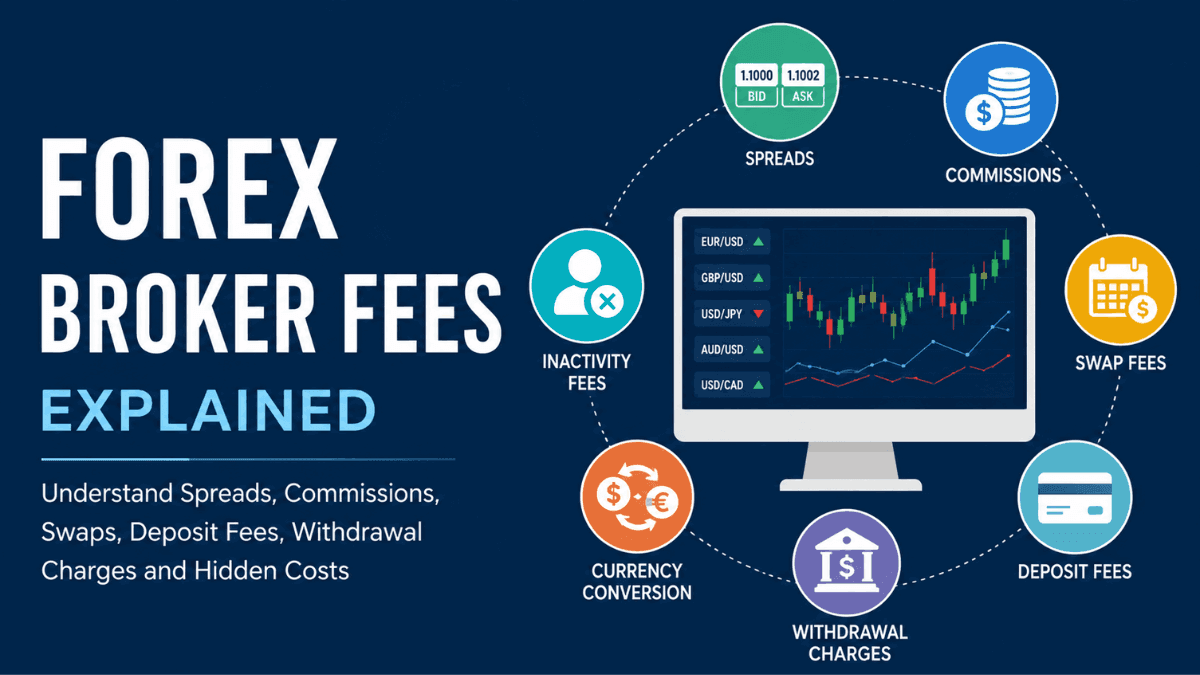
The most common revenue sources include:
- Spreads
- Trading commissions
- Overnight swap fees
- Deposit and withdrawal fees
- Currency conversion fees
- Inactivity charges
Not every broker charges every type of fee. Some advertise commission-free trading but offset it with wider spreads. Others offer ultra-tight spreads and charge a fixed commission instead.
Spread Fees Explained
For most traders, spreads represent the largest and most frequent trading expense.
What Is a Spread?
A spread is the difference between the buying price (ask) and the selling price (bid) of a currency pair.
For example:
| Currency Pair | Bid Price | Ask Price | Spread |
|---|---|---|---|
| EUR/USD | 1.1000 | 1.1001 | 1 pip |
If you enter a trade immediately, you start out slightly negative due to this difference. The market must move in your favor enough to cover the spread before you reach breakeven.
Fixed vs Variable Spreads
Some brokers offer fixed spreads, while others use variable spreads.
Fixed spreads remain constant under normal conditions. This can make trading costs more predictable, particularly during stable market conditions.
Variable spreads fluctuate according to market liquidity and volatility. During major news releases or periods of low liquidity, spreads may widen significantly.
Variable spreads are common among ECN (Electronic Communication Network) and STP (Straight Through Processing) brokers because pricing reflects real market conditions.
Why Spread Size Matters
A spread difference of one pip may appear small, but the impact grows quickly.
Suppose you regularly trade one standard lot of EUR/USD. If Broker A charges a 1-pip spread and Broker B charges a 2-pip spread, your trading costs double before any profit is generated.
For high-frequency traders, scalpers, and day traders, spread costs deserve careful attention.
Commission Fees Explained
Many professional trading accounts charge commissions in exchange for tighter spreads.
What Is a Trading Commission?
A commission is a direct fee charged when you open and close a trade.
For example, a broker may charge:
- $3 per side per lot
- $6 round trip per lot
A “side” refers to either opening or closing the position.
If you buy one standard lot and later close it, you pay the commission twice—once for entry and once for exit.
Why Brokers Charge Commissions
Commission-based pricing often provides access to raw spreads sourced directly from liquidity providers.
Instead of paying a wider spread, traders pay a transparent fee while benefiting from tighter market pricing.
This model is popular among:
- Professional traders
- Scalpers
- Algorithmic traders
- High-volume traders
Which Is Better: Spread-Only or Commission Accounts?
The answer depends on your trading style.
Spread-only accounts are simple and easy to understand. Beginners often prefer them because costs are built directly into the trade.
Commission accounts may offer lower overall costs, particularly for active traders who value tighter spreads and precise execution.
The key is to calculate the total trading cost rather than focus on a single fee in isolation.
Swap Fees and Overnight Financing Costs
If you hold positions overnight, swap fees become an important consideration.
What Is a Swap Fee?
A swap fee, also called overnight financing or rollover interest, is the charge or credit applied when a position remains open after the broker’s daily rollover time.
The fee exists because forex trading involves borrowing one currency to buy another.
Since every currency has its own interest rate, traders either pay or receive the difference between those rates.
Can You Earn Swap Income?
Yes, in certain situations.
If you hold a currency with a higher interest rate against one with a lower interest rate, you may receive a positive swap credit.
This approach is commonly known as a carry trade.
However, market conditions, broker policies, and central bank decisions can change swap values over time.
Triple Swap Wednesday
Many brokers apply a triple swap charge on Wednesdays.
This adjustment accounts for weekend settlement requirements in the forex market. Traders holding positions through Wednesday should understand how this can affect costs.
Deposit and Withdrawal Fees
Funding and withdrawing from your account may also involve costs.
Deposit Fees
Some brokers absorb payment processing costs and offer free deposits.
Others charge fees depending on the payment method used, such as:
- Credit cards
- Debit cards
- Bank transfers
- E-wallets
- Local payment systems
Before funding an account, review the broker’s payment policy carefully.
Withdrawal Fees
Withdrawal charges are more common than deposit fees.
A broker may:
- Offer free withdrawals
- Charge a flat fee
- Pass banking costs to the client
Frequent withdrawals can increase overall account expenses, particularly when international bank transfers are involved.
Third-Party Fees
Even if a broker advertises free withdrawals, your bank or payment provider may still charge transaction fees.
Always consider the complete payment chain when estimating costs.
Currency Conversion Fees
Many traders overlook conversion costs until they notice them on their account statements.
How Currency Conversion Fees Work
Suppose your trading account is denominated in USD, but you deposit funds in Kenyan Shillings, Euros, or British Pounds.
The funds must be converted into the account currency.
Brokers or payment providers may apply a conversion markup above the prevailing exchange rate.
Why These Fees Matter
For traders who frequently deposit or withdraw funds in different currencies, conversion fees can become substantial over time.
Choosing an account currency that matches your primary banking currency can help reduce these expenses.
Inactivity Fees Explained
Not every trader trades every month.
Some investors open accounts, trade occasionally, and leave funds untouched for extended periods. This is where inactivity fees may apply.
What Is an Inactivity Fee?
An inactivity fee is charged when no trading activity occurs for a specified period.
The timeframe varies between brokers and may range from three months to one year.
Why Brokers Charge Inactivity Fees
Maintaining dormant accounts still creates operational and regulatory costs.
Some brokers offset these expenses through inactivity charges.
How to Avoid Inactivity Fees
The simplest approach is reviewing the broker’s terms before opening an account.
Many reputable brokers offer accounts with no inactivity fees, making them attractive for long-term investors and casual traders.
Hidden Forex Broker Fees to Watch Out For
Not all costs are prominently displayed on a broker’s homepage.
Experienced traders always review the full fee schedule before opening an account.
Potential hidden costs include:
- Currency conversion markups
- Wire transfer fees
- Guaranteed stop-loss premiums
- Market data subscriptions
- Account maintenance charges
- Platform fees on specialized software
- Paper statement fees
A broker advertising “zero commission” trading may still generate significant revenue through these alternative charges.
How to Compare Forex Broker Fees Properly
Comparing brokers requires more than looking at one number.
Calculate Total Trading Costs
A broker with slightly higher commissions may still be cheaper overall if spreads are significantly tighter.
Always calculate:
Spread Cost + Commission Cost + Financing Charges = Total Trading Cost
This provides a more accurate comparison.
Consider Your Trading Style
Different traders face different costs.
Scalpers generally care most about spreads and commissions because they execute many trades.
Swing traders often focus on swap fees because positions remain open longer.
Long-term investors may prioritize inactivity fees and withdrawal costs.
Read the Fine Print
Broker marketing pages highlight advantages, but fee schedules reveal the full picture.
Review legal documents, account specifications, and payment policies before committing funds.
Examples of Forex Trading Costs
Real-world examples make broker fees easier to understand.
Example 1: Spread-Only Account
Suppose you trade one standard lot of EUR/USD.
- Spread: 1.5 pips
- Commission: $0
With a pip value of approximately $10, the cost equals roughly $15.
Example 2: Raw Spread Account
Suppose another broker offers:
- Spread: 0.2 pips
- Commission: $7 round trip
Spread cost equals approximately $2.
The total cost becomes about $9.
Despite charging commissions, the second account is cheaper in this example.
Actual costs vary based on instrument, trade size, market conditions, and broker pricing.
Are Low Broker Fees Always Better?
The cheapest broker is not necessarily the best broker.
Reliable execution, strong regulation, platform stability, and responsive customer support often provide more value than saving a fraction of a pip.
A broker with ultra-low fees but poor execution may ultimately cost traders more through slippage, requotes, or platform outages.
Cost should always be evaluated alongside quality and trustworthiness.
How to Reduce Your Forex Trading Costs
Most traders can lower their expenses without dramatically changing strategies.
Consider these practical approaches:
- Compare total costs instead of spreads alone
- Use account types suited to your trading style
- Avoid unnecessary currency conversions
- Monitor overnight financing charges
- Withdraw funds efficiently
- Review fee schedules regularly
- Trade during liquid market hours when spreads are typically tighter
Small savings accumulated consistently can improve long-term profitability.
Final Thoughts
Understanding forex broker fees is essential for making informed trading decisions. While spreads and commissions receive most of the attention, costs such as swap fees, withdrawal charges, currency conversion fees, and inactivity penalties can also affect your bottom line.
The best approach is to evaluate the broker’s complete pricing structure rather than focusing on a single fee. A transparent broker that clearly explains its costs helps you manage expenses effectively and focus on what matters most—developing a profitable trading strategy.
Frequently Asked Questions About Forex Broker Fees
What is the most common forex broker fee?
The spread is typically the most common forex trading fee. It represents the difference between the bid and ask price and is charged every time you enter a trade.
Do all forex brokers charge commissions?
No. Some brokers use spread-only pricing, while others offer raw spreads and charge commissions separately.
What is a swap fee in forex trading?
A swap fee is an overnight financing charge or credit applied when a position remains open past the broker’s rollover time.
Can I find a forex broker with no fees?
Not entirely. Even if a broker advertises commission-free trading, costs are usually incorporated into spreads or other account charges.
Are withdrawal fees common among forex brokers?
Yes. Many brokers charge withdrawal fees or pass payment processing costs to clients, although some offer free withdrawals.
Why do spreads widen during news events?
Major economic announcements increase market volatility and uncertainty. Liquidity providers widen pricing, temporarily increasing broker spreads.
Should beginners focus only on low spreads?
No. Regulation, platform reliability, customer support, execution quality, and overall transparency are just as important as low trading costs.
Trade Anytime, Anywhere with XM
Take your trading to the next level with a globally trusted forex and CFD broker. Enjoy competitive spreads, fast execution, and reliable customer support while trading securely.
With XM, you get access to powerful trading platforms, real-time charts, flexible account types, and advanced tools to help you analyze the markets and manage your trades efficiently. Start your journey today by opening a trading account for free and join millions of traders worldwide.
✅ Open an Account with XM
Vincent Nyagaka has been trading and analyzing markets for over 10+ years. He is a respected trader, author, and coach in financial markets, and is known as the authority on price action trading. At Eazypips, he shares practical strategies and trading lessons to guide aspiring traders toward consistent results.