Choosing a Forex broker is one of the most important decisions you’ll make as a trader. Even the best trading strategy can struggle if your broker has poor execution, high fees, weak regulation, or unreliable withdrawals. On the other hand, a reputable broker can provide a secure trading environment, competitive pricing, and the tools you need to grow as a trader.
The challenge is that hundreds of brokers compete for your attention. Many offer similar-looking websites, attractive bonuses, and promises of tight spreads. So how do you separate trustworthy brokers from those that may put your funds at risk?
Click Here To Join our Telegram Community
This guide explains exactly how to choose a Forex broker, what factors matter most, and the common mistakes traders should avoid before opening an account.
Why Choosing the Right Forex Broker Matters
Your broker acts as the bridge between you and the financial markets. Every trade you place, every deposit you make, and every withdrawal you request goes through them.
A poor broker can create problems such as delayed executions, hidden fees, withdrawal difficulties, or platform instability during volatile market conditions. These issues can directly affect your trading results regardless of your skill level.
A reliable broker provides transparent pricing, strong security measures, fast order execution, and responsive customer support. That creates an environment where you can focus on trading instead of worrying about operational issues.
Start With Regulation and Licensing
The first thing you should evaluate is regulation. Regulation refers to the legal oversight imposed by financial authorities to ensure brokers follow specific rules designed to protect clients.
A regulated broker must typically meet certain capital requirements, keep client funds separate from company funds, and comply with strict reporting standards.
Why Regulation Matters
Regulation helps reduce the risk of fraud and misconduct. While regulation cannot eliminate all risks, it provides an additional layer of protection and accountability.
If a broker operates without credible regulation, traders may have little recourse if disputes arise regarding withdrawals, pricing, or account management.
Major Regulatory Authorities
Some of the most respected financial regulators include:
- Financial Conduct Authority (FCA)
- Australian Securities and Investments Commission (ASIC)
- Cyprus Securities and Exchange Commission (CySEC)
- Commodity Futures Trading Commission (CFTC)
- Financial Sector Conduct Authority (FSCA)
Before opening an account, verify the broker’s license directly through the regulator’s official database rather than relying solely on claims displayed on the broker’s website.
Evaluate the Safety of Client Funds
After confirming the regulation, the next step is understanding how your money is protected.
Reputable brokers usually keep client funds in segregated accounts. This means client deposits are held separately from company operating funds.
Questions to Ask About Fund Security
Consider the following:
- Are client funds segregated?
- Does the broker offer negative balance protection?
- Which banks hold client funds?
- Is there investor compensation coverage where applicable?
These protections become especially important during periods of extreme market volatility.
Understand Trading Costs
Trading costs can significantly impact profitability over time. Many traders focus only on spreads while overlooking other expenses.
A spread is the difference between the buying price and selling price of a currency pair. This difference represents a primary source of revenue for many brokers.
Spread Types
Most brokers offer either fixed or variable spreads.
Fixed spreads remain relatively constant under normal conditions. Variable spreads fluctuate based on market liquidity and volatility.
Neither model is automatically better. The best choice depends on your trading style and market conditions.
Additional Costs to Consider
Beyond spreads, examine:
- Commissions
- Swap or overnight financing fees
- Deposit fees
- Withdrawal fees
- Currency conversion charges
- Inactivity fees
A broker with slightly wider spreads may actually be cheaper overall if it eliminates several additional charges.
Examine Execution Quality
Execution quality refers to how efficiently your trades are processed.
When markets move quickly, execution becomes especially important. Poor execution can result in slippage, where your trade is filled at a different price than expected.
Key Execution Factors
Look for brokers that provide:
- Fast order processing
- Minimal requotes
- Stable infrastructure
- Reliable liquidity sources
- Transparent execution policies
Scalpers and day traders should pay particular attention to execution quality because small price differences can have a significant impact on profitability.
Assess Available Trading Platforms
Your trading platform serves as your primary workspace. Even a well-regulated broker may not be ideal if its platform lacks the features you need.
Popular Trading Platforms
Many Forex brokers support:
- MetaTrader 4 (MT4)
- MetaTrader 5 (MT5)
- cTrader
- Proprietary broker platforms
Each platform has strengths and weaknesses.
MT4 remains popular because of its simplicity and extensive support for indicators and Expert Advisors (EAs). MT5 offers additional timeframes, improved backtesting capabilities, and access to more asset classes. cTrader is often favored by traders seeking advanced order management and modern charting features.
Platform Features Worth Evaluating
Pay attention to:
- Charting tools
- Technical indicators
- Mobile trading capability
- Automated trading support
- Speed and stability
- Ease of use
Most brokers provide demo accounts, allowing you to test the platform before committing real funds.
Check Available Markets and Instruments
Not every broker offers the same range of tradable products.
Some specialize in Forex trading, while others provide access to indices, commodities, stocks, cryptocurrencies, bonds, and exchange-traded funds.
Match Markets to Your Goals
Ask yourself:
- Will you trade only Forex?
- Do you want exposure to gold or oil?
- Are stock CFDs important to you?
- Do you plan to diversify later?
Choosing a broker that supports future expansion can save you from switching providers as your trading needs evolve.
Review Account Types
Most brokers offer multiple account options designed for different trader profiles.
The ideal account depends on your experience, capital, and trading strategy.
Common Account Types
Typical account offerings include:
- Standard accounts
- Micro accounts
- Cent accounts
- ECN accounts
- Raw spread accounts
- Islamic accounts
Beginners often benefit from micro or cent accounts because they allow smaller position sizes and lower risk exposure while learning.
More experienced traders may prefer ECN or raw spread accounts that offer tighter spreads combined with commission-based pricing.
Analyze Deposit and Withdrawal Methods
A broker’s deposit and withdrawal process reveals a great deal about its reliability.
Fast deposits are common across the industry. Fast withdrawals are what truly matter.
What to Look For
Evaluate:
- Processing speed
- Supported payment methods
- Withdrawal fees
- Minimum withdrawal amounts
- Verification requirements
If possible, test a small withdrawal before making a substantial deposit. This simple step can help identify potential issues early.
Consider Customer Support Quality
Strong customer support often becomes important when you least expect it.
Platform issues, verification delays, and account questions can occur at any time. Quick access to knowledgeable support can prevent minor problems from becoming major frustrations.
Signs of Good Support
Look for brokers that offer:
- Live chat
- Email support
- Telephone support
- Multilingual assistance
- Fast response times
Before funding an account, contact support with a few questions and evaluate how quickly and professionally they respond.
Research the Broker’s Reputation
Marketing materials only tell part of the story. Real client experiences can provide additional insight.
While online reviews should never be accepted blindly, patterns often reveal important information.
What Reviews Can Reveal
Pay attention to recurring comments about:
- Withdrawals
- Execution quality
- Customer support
- Platform stability
- Transparency
A handful of negative reviews is normal for any large broker. Consistent complaints about the same issue should raise concerns.
Evaluate Educational Resources
Many traders underestimate the value of broker-provided education.
Quality educational content can help beginners develop skills while providing advanced traders with market insights and analysis tools.
Useful Educational Features
Look for resources such as:
- Trading guides
- Video tutorials
- Webinars
- Market analysis
- Economic calendars
- Trading calculators
A broker that invests in trader education often demonstrates a long-term commitment to client success.
Understand Leverage Carefully
Leverage allows traders to control larger positions using smaller amounts of capital.
While leverage can increase potential profits, it also magnifies losses. This makes it one of the most important concepts to understand before trading.
Choosing Appropriate Leverage
Many beginners are attracted to extremely high leverage ratios because they appear to increase earning potential.
In reality, excessive leverage is one of the most common reasons new traders lose money. Responsible brokers provide leverage options while encouraging proper risk management.
Test the Broker With a Demo Account
A demo account offers a risk-free way to evaluate a broker’s services.
It allows you to explore the trading platform, test execution speed, and become familiar with account features before risking real capital.
What to Test During the Demo Period
Focus on:
- Order execution
- Platform reliability
- Charting capabilities
- Available instruments
- Ease of navigation
Treat the demo period as a practical evaluation rather than simply a practice environment.
Red Flags to Avoid
Certain warning signs should immediately make you more cautious.
While no single factor guarantees a broker is unsafe, multiple red flags deserve serious attention.
Common Broker Warning Signs
Be wary of brokers that:
- Operate without recognized regulation
- Promise guaranteed profits
- Make withdrawals difficult
- Hide fee structures
- Use aggressive sales tactics
- Lack of transparent company information
Legitimate brokers understand that trading involves risk and does not guarantee returns.
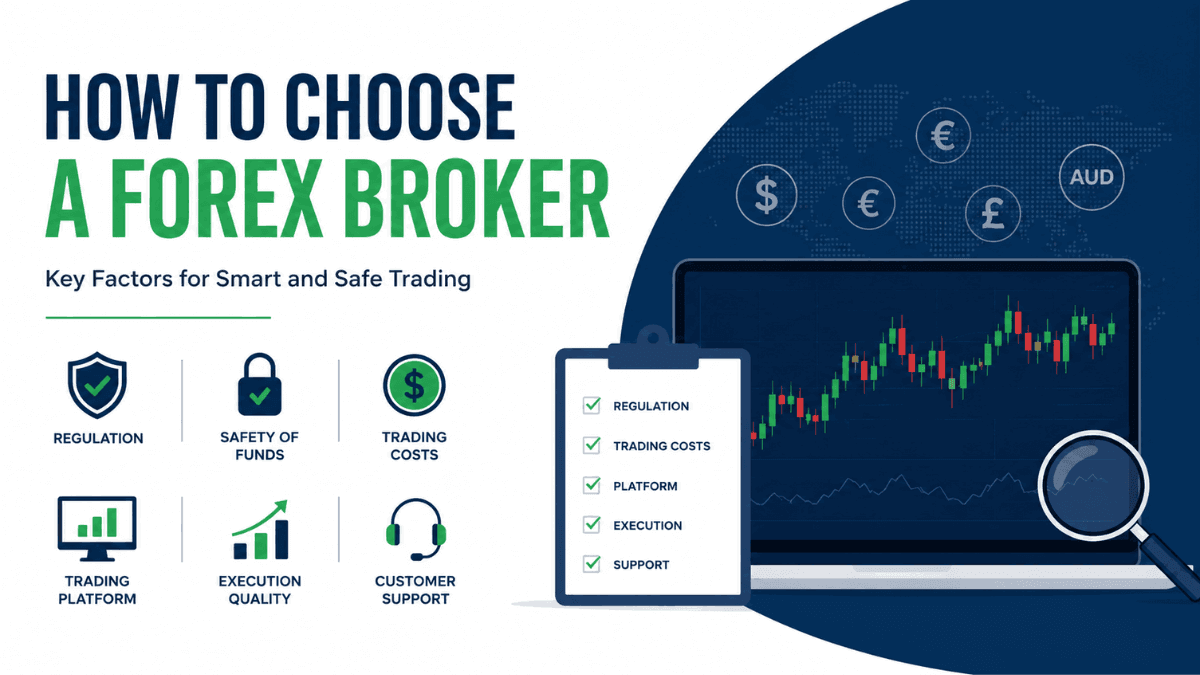
A Simple Checklist for Choosing a Forex Broker
Before opening an account, confirm that the broker:
- Holds credible regulatory licenses
- Protects client funds through segregation
- Offers competitive and transparent pricing
- Provides reliable execution
- Supports a trusted trading platform
- Processes withdrawals efficiently
- Maintains responsive customer support
- Has a strong industry reputation
- Offers educational resources
- Provides suitable account types
If a broker performs well across these areas, it is likely worth further consideration.
Common Mistakes Traders Make When Choosing a Broker
Many traders focus on the wrong factors when comparing brokers.
The most common mistake is choosing a broker solely because it offers high leverage or a promotional bonus. These features may look attractive initially, but they rarely determine long-term trading success.
Another mistake is ignoring regulation. Saving a fraction of a pip on spreads is meaningless if your funds are not adequately protected.
Finally, many traders fail to test withdrawals early. A small withdrawal test can reveal operational issues before significant capital is deposited.
Final Thoughts
Learning how to choose a Forex broker is a critical step in building a successful trading journey. Regulation, fund security, execution quality, pricing, platform reliability, and customer support all deserve careful consideration before you commit your money.
The best Forex broker is not necessarily the one with the lowest spread or the largest bonus. It is the broker that aligns with your trading goals, protects your funds, provides reliable execution, and maintains a strong reputation for transparency and professionalism.
Take your time, compare multiple brokers, verify their regulatory status, and test their services whenever possible. A thoughtful decision today can help you avoid costly problems and create a stronger foundation for long-term trading success.
Frequently Asked Questions
What is the most important factor when choosing a Forex broker?
Regulation is generally the most important factor because it helps ensure the broker operates under recognized financial standards and provides certain client protections.
Are low spreads always better?
Not necessarily. A broker with slightly higher spreads may offer better execution, lower commissions, or fewer hidden fees, resulting in lower overall trading costs.
Should beginners use high leverage?
Most beginners are better served by using lower leverage while learning risk management and trade execution.
How can I verify if a broker is regulated?
Visit the regulator’s official website and search for the broker’s license number or company name in the regulator’s database.
Is a demo account enough to evaluate a broker?
A demo account is an excellent starting point, but testing deposits, withdrawals, and customer support with a small live account provides a more complete evaluation.
What is a segregated client account?
A segregated account keeps client funds separate from the broker’s operating funds, helping protect customer money if the company experiences financial difficulties.
Can I trust online broker reviews?
Online reviews can be helpful when identifying recurring patterns, but they should be combined with regulatory checks, personal testing, and independent research.
Trade Anytime, Anywhere with XM
Take your trading to the next level with a globally trusted forex and CFD broker. Enjoy competitive spreads, fast execution, and reliable customer support while trading securely.
With XM, you get access to powerful trading platforms, real-time charts, flexible account types, and advanced tools to help you analyze the markets and manage your trades efficiently. Start your journey today by opening a trading account for free and join millions of traders worldwide.
✅ Open an Account with XM
Vincent Nyagaka has been trading and analyzing markets for over 10+ years. He is a respected trader, author, and coach in financial markets, and is known as the authority on price action trading. At Eazypips, he shares practical strategies and trading lessons to guide aspiring traders toward consistent results.