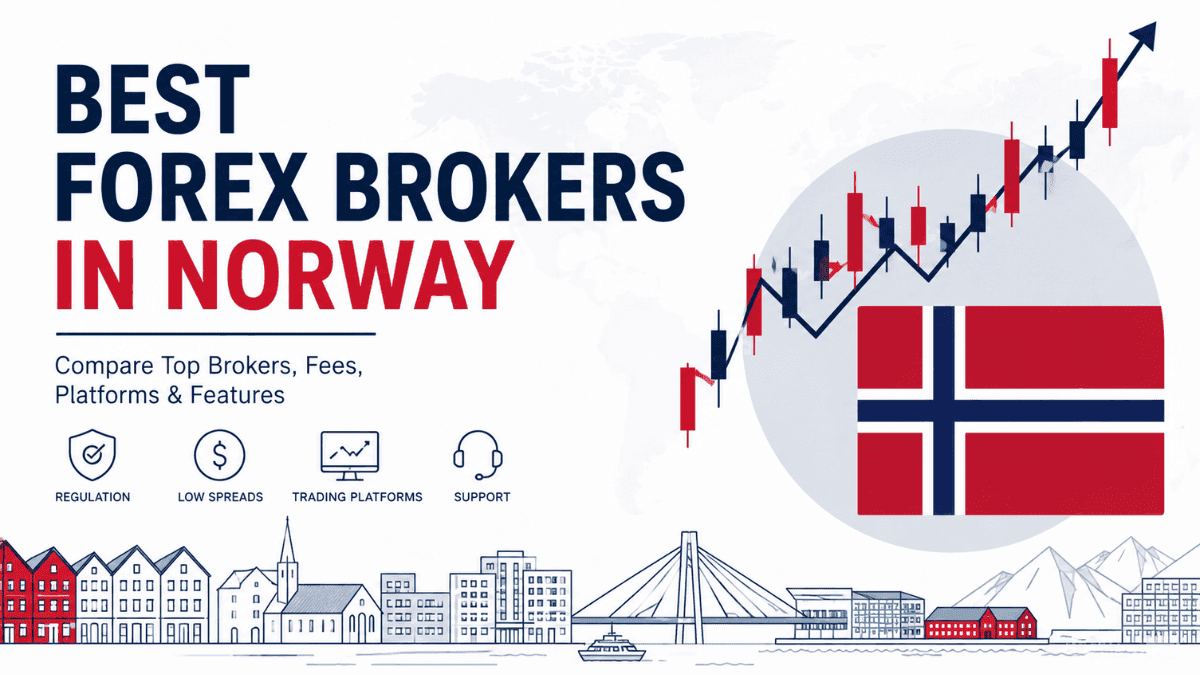
Norwegian traders have access to some of the world’s most reputable forex brokers, thanks to Norway’s close relationship with European financial markets and strong investor protection standards. Choosing among the best Forex brokers in Norway can be challenging because many international brokers offer competitive spreads, advanced trading platforms, and access to thousands of financial instruments.
The right broker depends on your trading style, experience level, and goals. A beginner may prioritize education and ease of use, while an experienced trader might focus on low spreads, fast execution, and advanced analytical tools. This guide explores the top forex brokers available to Norwegian traders and explains how to select the one that best fits your needs.

How Forex Trading Works in Norway
Norway has a well-developed financial system and a population that is generally comfortable with online investing. Forex trading is legal, and Norwegian residents can open accounts with both domestic and international brokers.
Although Norway is not a member of the European Union, it participates in the European Economic Area (EEA). This arrangement allows many European-regulated brokers to provide services to Norwegian traders under established regulatory frameworks.
Most forex trading in Norway takes place online through platforms such as MetaTrader 4 (MT4), MetaTrader 5 (MT5), TradingView, and proprietary broker platforms. Traders speculate on currency price movements without owning the underlying currencies.
What Norwegian Traders Should Look for in a Forex Broker
Before opening an account, it is important to understand what separates a high-quality broker from an average one.
Regulation and Security
Regulation should always be your first consideration. A regulated broker must comply with strict financial rules designed to protect clients.
Strong regulators include:
- Financial Conduct Authority (FCA) in the UK
- Cyprus Securities and Exchange Commission (CySEC)
- Australian Securities and Investments Commission (ASIC)
- Bundesanstalt für Finanzdienstleistungsaufsicht (BaFin) in Germany
Regulation cannot eliminate trading risk, but it significantly reduces the risk of broker misconduct.
Trading Costs
Forex brokers earn money through spreads, commissions, or both. Even small differences in trading costs can have a significant impact over hundreds of trades.
Look beyond advertised spreads and evaluate:
- Commission charges
- Overnight swap fees
- Deposit and withdrawal costs
- Currency conversion fees
Trading Platforms
A platform is your trading workspace. The best brokers provide reliable, intuitive, and feature-rich platforms.
Many Norwegian traders prefer MT4 and MT5 because of their familiarity and extensive ecosystem of indicators, Expert Advisors (EAs), and trading tools.
Available Markets
Many traders start with forex but later expand into other asset classes.
A broker offering multiple markets can provide access to:
- Forex pairs
- Stocks
- Indices
- Commodities
- ETFs
- Cryptocurrencies
Having everything under one account often simplifies portfolio management.
Customer Support
Customer support becomes especially important when dealing with account verification, withdrawals, or platform issues.
The best brokers provide responsive support through live chat, email, and telephone during trading hours.
Best Forex Brokers in Norway
The following brokers consistently rank among the strongest choices for Norwegian traders based on regulation, platform quality, pricing, and overall reputation.
1. IG Group
IG is one of the most established online trading companies in the world. Its reputation has been built over decades of operation and regulatory compliance.
Norwegian traders benefit from:
- Extensive market selection
- Competitive spreads
- Advanced charting tools
- Strong educational resources
- Professional-grade trading platforms
IG is particularly attractive to traders seeking access to more than just forex.
2. Saxo Bank
Saxo Bank is a premium broker that appeals to serious traders and investors. The broker provides access to thousands of instruments through sophisticated proprietary platforms.
Key advantages include:
- Institutional-grade technology
- Excellent research tools
- Deep market access
- Strong regulatory oversight
Saxo is often favored by experienced traders and high-net-worth investors.
3. Interactive Brokers
Interactive Brokers is widely respected for its low trading costs and extensive global market access.
The broker offers:
- Access to dozens of exchanges worldwide
- Competitive commissions
- Advanced professional tools
- Strong risk management features
It is especially suitable for traders who combine forex trading with stock and ETF investing.
4. CMC Markets
CMC Markets has earned a strong reputation for its pricing and technology.
Norwegian traders appreciate:
- Tight spreads
- Powerful charting capabilities
- High-quality research
- Wide product selection
Its Next Generation platform is considered one of the best proprietary trading platforms available today.
5. Pepperstone
Pepperstone is a favorite among active forex traders who prioritize speed and low costs.
Highlights include:
- Fast execution
- Raw spread accounts
- MT4, MT5, and TradingView support
- Competitive commissions
Scalpers and algorithmic traders often choose Pepperstone because of its trading infrastructure.
6. IC Markets
IC Markets has become one of the largest retail forex brokers globally.
The broker stands out because of:
- Very low spreads
- Deep liquidity access
- Fast execution
- Strong support for automated trading
For traders focused purely on forex efficiency, IC Markets remains a leading option.
7. XM
XM is known for its beginner-friendly environment and educational support.
Advantages include:
- Low minimum deposits
- Educational webinars
- User-friendly account setup
- Multiple account types
New traders often find XM easier to navigate than some of the more advanced platforms.
8. AvaTrade
AvaTrade offers a balanced package suitable for traders at different experience levels.
Notable features include:
- Multiple trading platforms
- Copy trading options
- Educational resources
- Strong regulatory framework
The broker is often recommended for traders who value simplicity and flexibility.
Comparing the Top Forex Brokers in Norway
| Broker | Best For | Platforms | Minimum Deposit |
|---|---|---|---|
| IG | Overall trading experience | MT4, Proprietary | Low |
| Saxo Bank | Professional traders | SaxoTraderGO, SaxoTraderPRO | Moderate |
| Interactive Brokers | Global investing | Trader Workstation | Low |
| CMC Markets | Research and charting | Next Generation, MT4 | Low |
| Pepperstone | Active traders | MT4, MT5, TradingView | Low |
| IC Markets | Low spreads | MT4, MT5, cTrader | Low |
| XM | Beginners | MT4, MT5 | Very low |
| AvaTrade | Multi-platform trading | MT4, MT5, AvaTradeGO | Low |
Is Forex Trading Taxable in Norway?
Tax considerations are important for every trader. Profits earned from forex trading may be subject to Norwegian taxation depending on your circumstances and how your trading activity is classified.
Tax rules can change, and individual situations vary significantly. For this reason, traders should consult a qualified tax professional or review guidance from the relevant Norwegian tax authorities before filing returns.
Maintaining accurate trading records throughout the year can make tax reporting significantly easier.
Which Trading Platform Is Best for Norwegian Traders?
The ideal platform depends on how you trade.
MT4 remains popular for its simplicity and extensive library of indicators and automated strategies. MT5 expands on MT4 by offering additional order types, more timeframes, and broader market coverage.
TradingView has gained popularity among Norwegian traders who value advanced charting and social trading features. Meanwhile, proprietary platforms from brokers like Saxo Bank and CMC Markets offer integrated research and portfolio management tools.
Should Beginners Trade Forex in Norway?
Forex trading can be accessible to beginners, but it should not be approached casually.
New traders often underestimate the impact of leverage. Leverage allows traders to control larger positions with smaller amounts of capital, which can magnify both profits and losses.
A sensible approach includes:
- Starting with a demo account
- Learning risk management
- Using small position sizes
- Developing a trading plan
- Avoiding emotional decision-making
Treating forex trading as a skill rather than a shortcut to quick profits generally leads to better long-term outcomes.
How to Choose the Best Forex Broker in Norway
Selecting a broker becomes easier when you focus on your priorities.
If you are a beginner, educational support and ease of use may matter most. If you trade frequently, spreads and commissions become more important. Investors who want exposure to stocks, ETFs, and forex from a single account may prefer brokers with broader market access.
Before depositing money, consider:
- Regulatory status
- Trading costs
- Platform quality
- Market availability
- Deposit and withdrawal options
- Customer support quality
- Educational resources
Opening a demo account with two or three brokers can help you compare the actual trading experience before committing real funds.
Final Verdict
Norwegian traders have access to some of the industry’s most respected brokers, giving them a wide range of choices regardless of experience level or trading strategy.
For overall quality, IG and Saxo Bank remain standout options. Traders seeking low-cost forex execution often gravitate toward Pepperstone and IC Markets. Beginners often appreciate XM and AvaTrade for their educational resources and accessible account structures. Interactive Brokers is an excellent choice for those who want to combine forex trading with global investing.
The best Forex broker in Norway ultimately depends on your individual goals. Focus on regulation, transparency, platform quality, and trading costs, and you’ll be in a strong position to find a broker that supports your long-term success.
Frequently Asked Questions
What is the best forex broker in Norway?
There is no single broker that suits every trader. IG, Saxo Bank, Pepperstone, IC Markets, and Interactive Brokers are among the most respected choices available to Norwegian traders.
Is forex trading legal in Norway?
Yes. Forex trading is legal in Norway, and residents can open accounts with regulated brokers that serve Norwegian clients.
Can beginners trade forex in Norway?
Yes, beginners can trade forex in Norway. Starting with a demo account and focusing on education before risking real money is generally the safest approach.
Which forex broker has the lowest spreads?
IC Markets and Pepperstone are frequently recognized for offering very competitive spreads, particularly on major currency pairs. Actual costs depend on account type and market conditions.
Do Norwegian traders pay tax on forex profits?
Forex profits may be taxable in Norway depending on your circumstances. Traders should maintain accurate records and seek professional tax advice when necessary.
What trading platform is most popular in Norway?
MetaTrader 4 and MetaTrader 5 remain extremely popular among forex traders. TradingView has also experienced strong growth because of its advanced charting capabilities.
How much money do I need to start forex trading in Norway?
Many brokers allow accounts to be opened with relatively small deposits. While some brokers accept deposits under $100, traders should only risk capital they can afford to lose and focus on proper risk management from the start.
Trade Anytime, Anywhere with XM
Take your trading to the next level with a globally trusted forex and CFD broker. Enjoy competitive spreads, fast execution, and reliable customer support while trading securely.
With XM, you get access to powerful trading platforms, real-time charts, flexible account types, and advanced tools to help you analyze the markets and manage your trades efficiently. Start your journey today by opening a trading account for free and join millions of traders worldwide.
✅ Open an Account with XM
Vincent Nyagaka has been trading and analyzing markets for over 10+ years. He is a respected trader, author, and coach in financial markets, and is known as the authority on price action trading. At Eazypips, he shares practical strategies and trading lessons to guide aspiring traders toward consistent results.