Choosing between ECN vs Market Maker Brokers is one of the most important decisions a forex trader can make. Your broker influences everything from trading costs and execution speed to spreads and overall trading experience.
Many beginners open an account without understanding how their broker processes trades. As a result, they may end up paying higher costs, experiencing unexpected slippage, or using a broker model that doesn’t match their trading style.
Click Here To Join our Telegram Community
This guide explains exactly how ECN and Market Maker brokers work, their advantages and disadvantages, and how to decide which option fits your trading goals.
Understanding Forex Broker Models
Before comparing ECN and Market Maker brokers, it’s important to understand what happens when you place a trade.
When you click Buy or Sell on your trading platform, your order must be matched with someone willing to take the opposite side. Different broker models handle this process in different ways.
Some brokers connect traders directly to liquidity providers such as banks and financial institutions. Others create an internal market and act as the counterparty to client trades.
This distinction forms the foundation of the ECN versus Market Maker debate.
What Is an ECN Broker?
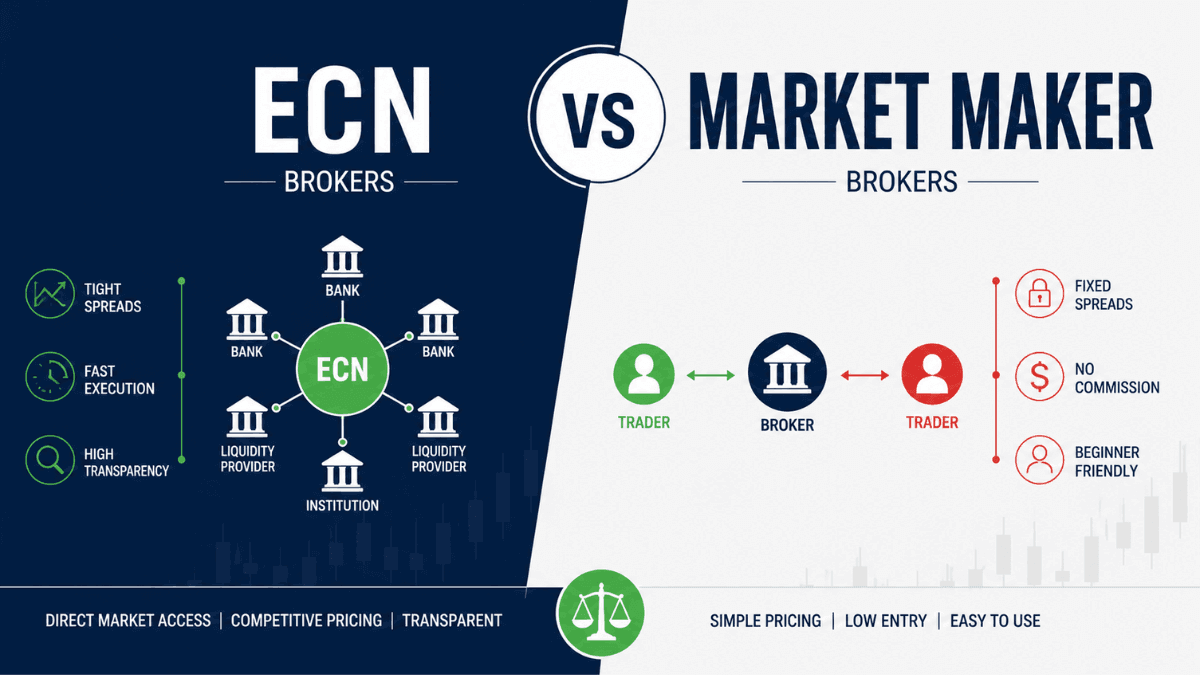
An ECN broker uses an Electronic Communication Network (ECN) to connect traders directly with liquidity providers.
Instead of taking the opposite side of your trade, the broker routes your order into a network where banks, hedge funds, institutional traders, and other market participants compete to provide prices.
Because multiple liquidity providers are competing for orders, traders often receive highly competitive spreads.
How ECN Brokers Work
When you place a trade with an ECN broker:
- Your order enters the ECN network.
- The system searches for the best available price.
- The order is matched with another participant.
- The broker earns money through commissions rather than trading against you.
This model is designed to provide transparent pricing and market-driven execution.
Key Characteristics of ECN Brokers
ECN brokers typically offer:
- Raw spreads that can start from 0.0 pips
- Commission-based pricing
- Direct market access
- Fast execution speeds
- Variable spreads
- Level II market depth information
Because pricing comes directly from liquidity providers, spreads fluctuate depending on market conditions.
What Is a Market Maker Broker?
A Market Maker broker creates its own market by quoting buy and sell prices to clients.
Instead of sending every trade to external liquidity providers, the broker may internally match orders or act as the counterparty to client positions.
This model is common among retail forex brokers because it allows them to provide stable pricing and fixed spreads.
How Market Maker Brokers Work
When a trader places an order:
- The broker receives the trade.
- The broker may match it against another client order.
- If no matching order exists, the broker may take the opposite side.
- The broker earns revenue through spreads and risk management.
Although this arrangement sometimes raises concerns about conflicts of interest, many regulated market makers operate fairly and transparently.
Key Characteristics of Market Maker Brokers
Market Maker brokers often provide:
- Fixed or wider spreads
- No commission accounts
- Lower minimum deposits
- Simplified trading conditions
- Better suitability for beginners
Many popular retail brokers use a market-making model because it makes forex trading accessible to smaller traders.
ECN vs Market Maker Brokers: The Main Differences
Understanding the practical differences helps traders choose the right type of broker.
| Feature | ECN Broker | Market Maker Broker |
|---|---|---|
| Order Routing | Sent to liquidity providers | Handled internally or matched by a broker |
| Spreads | Variable, often very low | Fixed or wider |
| Commissions | Usually charged | Often none |
| Market Access | Direct | Indirect |
| Execution Speed | Generally very fast | Fast, but depends on the broker |
| Transparency | High | Moderate |
| Minimum Deposit | Often higher | Usually lower |
| Suitable for Scalping | Excellent | Depends on broker |
| Level II Pricing | Often available | Rare |
While these differences matter, neither model is automatically better than the other.
ECN Broker Advantages
Many experienced traders prefer ECN brokers for the transparency and direct market access they offer.
Tighter Spreads
One of the biggest attractions of ECN trading is access to raw spreads.
During liquid market conditions, major currency pairs such as EUR/USD can have spreads close to zero.
For active traders, these savings can significantly reduce trading costs over time.
Reduced Conflict of Interest
Since ECN brokers earn commissions rather than trading against clients, there is generally less concern that the broker benefits from traders’ losses.
This creates a business model that more closely aligns with traders’ success.
Faster Execution
ECN brokers typically use sophisticated infrastructure that allows orders to be executed quickly.
This is especially important for scalpers, day traders, and algorithmic trading systems.
Greater Transparency
Many ECN platforms display market depth information, allowing traders to see available liquidity at different price levels.
This provides insight into actual market conditions rather than relying solely on broker quotes.
ECN Broker Disadvantages
While ECN brokers offer several advantages, they are not perfect.
Commission Costs
Instead of embedding costs into spreads, ECN brokers typically charge a commission per trade.
New traders sometimes focus only on low spreads and overlook additional commission costs.
Variable Spreads
Raw spreads can widen significantly during:
- Major news releases
- Economic announcements
- Low liquidity periods
- Market openings and closings
A spread that is normally 0.2 pips may temporarily jump to several pips during volatile events.
Higher Capital Requirements
Many ECN accounts require larger minimum deposits than standard retail accounts.
Although this trend has shifted in recent years, some true ECN brokers still primarily serve active traders.
Market Maker Broker Advantages
Market Maker brokers remain extremely popular among retail traders for good reasons.
Lower Entry Barriers
Most Market Maker brokers allow traders to open accounts with small deposits.
This makes forex trading accessible to beginners who want to learn without committing large amounts of capital.
Fixed Spreads
Many Market Maker accounts offer fixed spreads.
This predictability can help traders estimate trading costs more accurately, especially during normal market conditions.
No Commission Accounts
Many traders appreciate the simplicity of spread-only pricing.
Instead of calculating commissions separately, trading costs are included within the spread.
User-Friendly Environment
Market Maker brokers often focus heavily on beginner-friendly features such as:
- Educational resources
- Demo accounts
- Simple account structures
- Customer support
- Low minimum trade sizes
These features can make the learning process easier.
Market Maker Broker Disadvantages
Market Maker brokers also have limitations that traders should understand.
Potential Conflict of Interest
When the broker acts as the counterparty to client trades, a perceived conflict of interest exists.
That does not mean the broker manipulates prices, especially if it operates under strict regulatory oversight. Still, some traders prefer avoiding the issue entirely.
Wider Spreads
Market Maker brokers generally offer wider spreads than raw-spread ECN accounts.
For occasional traders, the difference may be negligible. For high-frequency traders, it can become significant.
Restrictions on Certain Strategies
Some Market Maker brokers may restrict or discourage:
- High-frequency scalping
- Latency arbitrage
- Certain automated strategies
Traders should always review broker policies before opening an account.
Which Broker Type Is Better for Scalping?
Scalping relies on capturing small price movements repeatedly throughout the trading day.
Because profit targets are often only a few pips, trading costs become extremely important.
ECN brokers generally perform better for scalpers because they provide:
- Lower spreads
- Faster execution
- Direct market access
- Fewer restrictions
A trader targeting five pips per trade may find a significant difference between paying 0.5 pips versus 2.0 pips in trading costs.
Which Broker Type Is Better for Beginners?
New traders often benefit from simplicity rather than advanced execution features.
A reputable Market Maker broker can offer:
- Low minimum deposits
- Straightforward pricing
- Educational tools
- User-friendly platforms
Many beginners are not trading frequently enough for ECN advantages to outweigh the additional complexity of commission-based pricing.
As trading experience grows, some traders later migrate to ECN accounts.
Which Broker Type Is Better for Algorithmic Trading?
Automated trading systems often depend on execution quality and low trading costs.
ECN brokers typically provide advantages such as:
- Reduced latency
- Better pricing transparency
- Lower spreads
- High-speed execution
For Expert Advisors (EAs) and algorithmic strategies, these factors can have a measurable impact on long-term performance.
How Regulation Matters More Than Broker Type
Many traders spend too much time debating broker models and not enough time evaluating regulation.
A well-regulated Market Maker broker is usually safer than an unregulated ECN broker.
When choosing a broker, prioritize regulatory oversight from respected authorities whenever possible.
Examples include:
- Financial Conduct Authority (FCA)
- Australian Securities and Investments Commission (ASIC)
- Cyprus Securities and Exchange Commission (CySEC)
Strong regulation helps protect client funds and ensures compliance with industry standards.
Common Myths About ECN and Market Maker Forex Brokers
Several misconceptions continue to circulate within the forex industry.
Myth 1: ECN Brokers Are Always Better
ECN brokers offer benefits, but they are not automatically superior for every trader.
Many casual traders achieve excellent results with reputable Market Maker brokers.
Myth 2: Market Makers Always Trade Against Clients
Many modern Market Maker brokers hedge risk externally and use sophisticated risk management systems.
The simplistic idea that every trade is directly taken by the broker is often inaccurate.
Myth 3: ECN Means Zero Trading Costs
Raw spreads may be extremely low, but commissions still apply.
The total trading cost should always include both spread and commission.
Myth 4: All ECN Brokers Are True ECN Brokers
Some brokers market themselves as ECN brokers while operating hybrid execution models.
Always review the broker’s execution policy and regulatory disclosures.
How to Choose Between ECN and Market Maker Brokers
The best choice depends on your trading style, capital, and objectives.
Choose an ECN broker if you:
- Trade frequently
- Use scalping strategies
- Run automated systems
- Need direct market access
- Value transparency
Choose a Market Maker broker if you:
- Are a beginner
- Have a small account balance
- Prefer simple pricing
- Trade less frequently
- Value educational support
Your broker should support your strategy rather than force you to adapt your strategy to its limitations.
Final Thoughts
The debate around ECN vs Market Maker Brokers often creates the impression that one model is universally better than the other. In reality, both serve different types of traders.
ECN brokers typically provide tighter spreads, faster execution, and greater transparency, making them attractive to active traders, scalpers, and algorithmic traders. Market Maker brokers often deliver lower barriers to entry, simpler pricing, and beginner-friendly trading environments.
The most important factor is not whether a broker is ECN or Market Maker. It is whether the broker is well-regulated, trustworthy, transparent about its execution model, and suitable for your specific trading needs. Choosing a broker that aligns with your trading style will have a far greater impact on your success than the label attached to its business model.
Frequently Asked Questions About ECN vs Market Makers
What does ECN stand for in forex trading?
ECN stands for Electronic Communication Network. It is a system that connects traders directly with liquidity providers, banks, and other market participants.
Are ECN brokers safer than Market Maker brokers?
Not necessarily. Safety depends primarily on regulation, client fund protection, and broker reputation rather than the execution model itself.
Do ECN brokers have lower spreads?
In most cases, yes. ECN brokers often offer raw spreads lower than those offered by Market Maker brokers, although commissions are usually charged separately.
Can beginners use ECN brokers?
Yes, beginners can use ECN brokers. However, commission-based pricing and variable spreads may be more difficult for new traders to understand initially.
Do Market Maker brokers manipulate prices?
Reputable, regulated Market Maker brokers are required to adhere to strict standards and pricing procedures. Traders should always choose brokers with strong regulatory oversight.
Which broker type is best for scalping?
ECN brokers are generally preferred for scalping because they offer tighter spreads, faster execution speeds, and fewer restrictions on trading strategies.
Is a zero-spread account always an ECN account?
No. Some brokers offer promotional or specialized zero-spread accounts that do not operate under a true ECN model. Always review the broker’s execution policy before opening an account.
Trade Anytime, Anywhere with XM
Take your trading to the next level with a globally trusted forex and CFD broker. Enjoy competitive spreads, fast execution, and reliable customer support while trading securely.
With XM, you get access to powerful trading platforms, real-time charts, flexible account types, and advanced tools to help you analyze the markets and manage your trades efficiently. Start your journey today by opening a trading account for free and join millions of traders worldwide.
✅ Open an Account with XM
Vincent Nyagaka has been trading and analyzing markets for over 10+ years. He is a respected trader, author, and coach in financial markets, and is known as the authority on price action trading. At Eazypips, he shares practical strategies and trading lessons to guide aspiring traders toward consistent results.