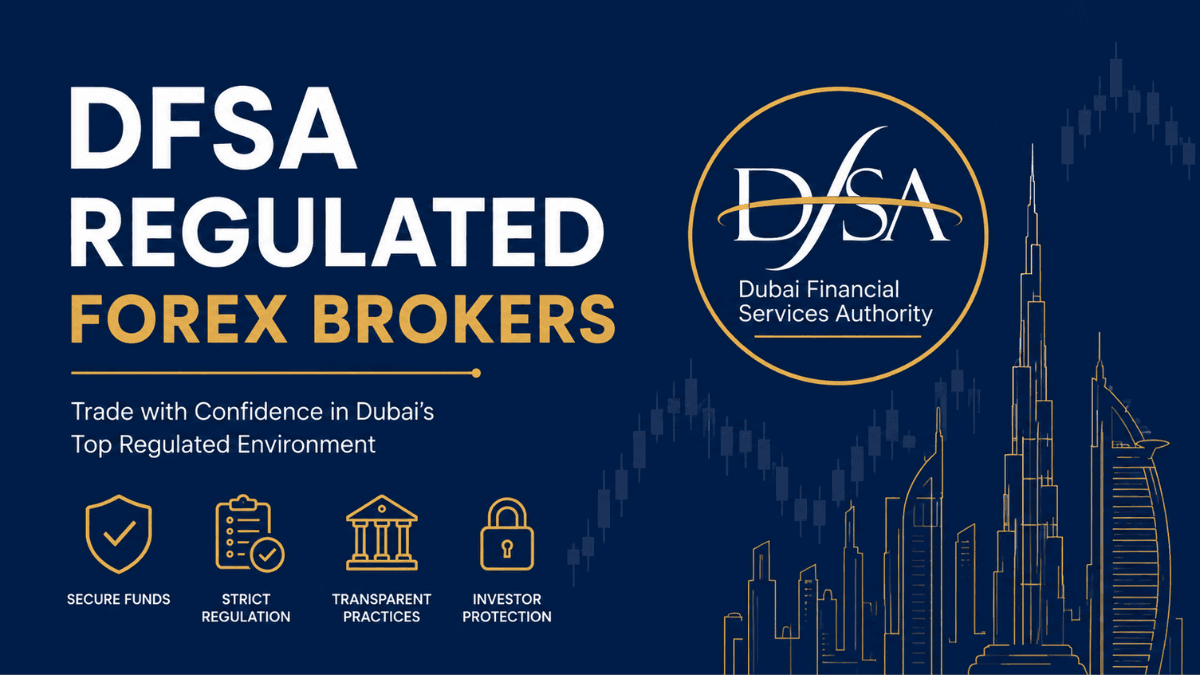
When choosing a forex broker, regulation should be one of the first factors you consider. DFSA-regulated Forex Brokers operate under the oversight of the Dubai Financial Services Authority (DFSA), one of the most respected financial regulators in the Middle East. For traders seeking a secure trading environment, strong compliance standards, and transparent business practices, DFSA-regulated brokers offer an additional layer of confidence.
Dubai has emerged as a major global financial hub, attracting international financial institutions, investment firms, and forex brokers. The DFSA plays a central role in maintaining market integrity and protecting investors within the Dubai International Financial Center (DIFC).

This guide explains how DFSA regulation works, why it matters, how to verify a broker’s license, and what traders should know before opening an account with a DFSA-regulated forex broker.
What Is the DFSA?
The Dubai Financial Services Authority (DFSA) is the independent regulator responsible for overseeing financial services conducted within the Dubai International Financial Center (DIFC).
Established in 2004, the DFSA regulates a wide range of financial activities, including banking, asset management, securities trading, insurance, and forex brokerage services. Its primary objective is to create a fair, transparent, and well-regulated financial environment that protects investors and promotes market confidence.
Unlike some offshore regulators that provide minimal oversight, the DFSA applies rigorous standards relating to licensing, risk management, compliance, anti-money laundering controls, and client fund protection.
Why DFSA Regulation Matters for Forex Traders
Choosing a regulated broker is one of the simplest ways to reduce trading risk. While regulation cannot eliminate market losses, it can help protect traders from fraud, misconduct, and unethical business practices.
DFSA-regulated brokers must adhere to strict operational requirements designed to safeguard clients and maintain financial stability.
Some of the key benefits include:
- Client fund segregation
- Capital adequacy requirements
- Regular audits and reporting
- Compliance monitoring
- Anti-money laundering controls
- Transparent business practices
- Risk management standards
These requirements help ensure that brokers operate responsibly and maintain sufficient financial resources to support their business activities.
Understanding the Dubai International Financial Center (DIFC)
To understand DFSA regulation, it is important to understand the DIFC’s role.
The Dubai International Financial Center is a special financial free zone established to serve businesses operating across the Middle East, Africa, and South Asia. It has its own legal framework, courts, and regulatory system.
The DFSA regulates financial firms operating within the DIFC rather than the entire United Arab Emirates. This distinction is important because brokers licensed elsewhere in the UAE may fall under different regulatory authorities.
Many global financial institutions choose the DIFC because of its internationally recognized regulatory framework and business-friendly environment.
How DFSA-Regulated Forex Brokers Are Licensed
Obtaining a DFSA license is not a simple process. Forex brokers must undergo extensive scrutiny before they are authorized to offer services within the DIFC.
Capital Requirements
The DFSA requires licensed firms to maintain adequate capital reserves. These financial requirements help ensure brokers can meet their obligations and continue operating during periods of market stress.
Higher capital standards generally contribute to greater financial stability.
Compliance Systems
Brokers must establish robust compliance procedures to monitor internal operations and ensure adherence to DFSA regulations.
This includes employee training, transaction monitoring, recordkeeping, and regulatory reporting.
Risk Management Controls
Risk management is a core part of DFSA oversight. Brokers must implement policies designed to identify, assess, and manage operational, financial, and market risks.
These systems help reduce the likelihood of major compliance failures or financial instability.
Ongoing Supervision
DFSA regulation is not a one-time approval process. Licensed firms remain subject to ongoing supervision, inspections, reporting obligations, and periodic reviews.
If a broker fails to meet regulatory standards, the DFSA has the authority to impose penalties, restrictions, or license suspensions.
Features Commonly Found in DFSA-Regulated Forex Brokers
While trading conditions vary between brokers, many DFSA-regulated firms share certain characteristics due to regulatory requirements.
Segregated Client Accounts
Client funds are typically held separately from company operating funds.
This segregation helps protect customers’ money if the broker experiences financial difficulties, as client deposits are not mixed with business capital.
Transparent Pricing
DFSA-regulated brokers are expected to provide clear information regarding spreads, commissions, fees, and trading conditions.
Transparent pricing allows traders to better understand the true cost of trading.
Professional Customer Support
Most regulated brokers invest heavily in customer service and compliance teams.
Clients generally have access to support channels that can assist with account issues, funding questions, and regulatory concerns.
Robust Trading Infrastructure
Many DFSA-regulated firms cater to institutional and professional traders, which often results in high-quality trading technology, competitive execution speeds, and advanced trading platforms.
How DFSA Compares to Other Forex Regulators
Not all regulators apply the same standards. Some jurisdictions are known for strict oversight, while others maintain lighter regulatory requirements.
DFSA vs FCA
The UK’s Financial Conduct Authority (FCA) is widely regarded as one of the world’s strongest regulators.
The DFSA shares many similarities with the FCA in terms of compliance expectations and supervision, although the FCA has a longer regulatory history and broader global influence.
DFSA vs ASIC
Australia’s Australian Securities and Investments Commission (ASIC) is another highly respected regulator.
Both regulators emphasize transparency, capital adequacy, and client protection. Traders often view both jurisdictions as trustworthy options.
DFSA vs Offshore Regulators
Offshore regulators generally impose fewer compliance obligations and lower capital requirements.
While some offshore brokers operate responsibly, regulatory protection is often weaker compared to DFSA oversight.
For traders prioritizing safety, DFSA regulation usually offers significantly stronger investor protections.
How to Verify a DFSA-Regulated Forex Broker
Before opening an account, it is important to independently verify a broker’s regulatory status.
Check the DFSA Register
Legitimate brokers should appear in the official DFSA public register.
The register contains information about licensed firms, authorized activities, and current regulatory status.
Review License Details
Do not rely solely on marketing claims displayed on a broker’s website.
Verify that the company name, license number, and authorized activities match the information listed in the regulatory database.
Examine Contact Information
Licensed firms typically provide transparent corporate information, including office addresses, registration details, and regulatory disclosures.
Missing or vague information can be a warning sign.
Read Legal Documentation
Terms and conditions, client agreements, and risk disclosures can provide valuable insights into how a broker operates.
Professional brokers generally make these documents easily accessible.
Potential Risks Even With DFSA-Regulated Brokers
Regulation improves safety, but it does not eliminate all risks associated with forex trading.
Market Risk
Currency markets can move rapidly, resulting in gains or losses.
Even with a highly regulated broker, traders can lose money due to unfavorable market movements.
Leverage Risk
Leverage allows traders to control larger positions with a smaller deposit.
While leverage can amplify profits, it can also magnify losses significantly.
Strategy Risk
A poorly designed trading strategy can result in losses regardless of broker quality.
Successful trading requires proper risk management, education, and discipline.
Emotional Trading
Fear, greed, and overconfidence remain major causes of trading losses.
No regulator can protect traders from poor decision-making.
Who Should Consider a DFSA-Regulated Forex Broker?
DFSA-regulated brokers can be particularly attractive for traders who prioritize security and regulatory oversight.
They may be suitable for:
- Traders based in the Middle East
- Investors seeking strong regulatory protections
- High-net-worth individuals
- Professional traders
- Institutional clients
- Beginners who value broker credibility
The combination of regulatory supervision and Dubai’s status as a global financial center makes DFSA-regulated brokers appealing to a broad range of market participants.
Key Factors to Evaluate Beyond Regulation
While regulation is important, it should not be the only factor influencing your decision.
Trading Costs
Compare spreads, commissions, swap rates, and withdrawal fees.
Even among regulated brokers, trading costs can vary considerably.
Available Markets
Some brokers focus primarily on forex, while others offer access to stocks, commodities, indices, cryptocurrencies, and exchange-traded funds.
Choose a broker that aligns with your trading goals.
Trading Platforms
Platform quality can significantly impact your trading experience.
Popular platforms often include MetaTrader 4 (MT4), MetaTrader 5 (MT5), cTrader, and proprietary trading solutions.
Deposit and Withdrawal Options
Reliable funding methods and efficient withdrawal processing contribute to a better overall trading experience.
Review available payment methods before opening an account.
Educational Resources
Many brokers provide market analysis, webinars, trading courses, and educational materials.
These resources can be especially valuable for newer traders.
Are DFSA-Regulated Forex Brokers Safe?
No broker can be considered completely risk-free. However, DFSA regulation generally provides a high level of confidence compared to many less-regulated jurisdictions.
The regulator’s emphasis on transparency, compliance, financial stability, and investor protection helps create a safer trading environment. Traders still need to conduct their own due diligence, but a DFSA license is often viewed as a positive sign of broker credibility.
For many traders in the Middle East and beyond, choosing a DFSA-regulated broker can be an effective way to balance market access with regulatory protection.
Conclusion
DFSA-regulated Forex Brokers operate under one of the Middle East’s most respected financial regulatory frameworks. Through strict licensing requirements, ongoing supervision, capital adequacy standards, and compliance controls, the DFSA helps promote trust and transparency within the forex industry.
While regulation should never be the only factor when choosing a broker, it remains one of the most important. A DFSA license demonstrates that a broker has met rigorous standards and continues to operate under regulatory oversight.
Before opening an account, verify the broker’s regulatory status, evaluate trading costs, review available platforms, and ensure the broker’s services match your trading objectives. Taking these steps can help you make a more informed decision and trade with greater confidence.
Frequently Asked Questions
What does DFSA stand for?
DFSA stands for Dubai Financial Services Authority. It is the independent regulator responsible for overseeing financial services conducted within the Dubai International Financial Center (DIFC).
Are DFSA-regulated brokers legitimate?
A DFSA license generally indicates that a broker has met strict regulatory requirements and is subject to ongoing supervision. Traders should still verify the broker’s license independently.
Is DFSA regulation considered strong?
Yes. The DFSA is widely regarded as a reputable financial regulator that enforces robust standards for compliance, risk management, and investor protection.
Can international traders use DFSA-regulated brokers?
Many DFSA-regulated brokers accept clients from multiple countries, although availability depends on the broker’s licensing permissions and local regulations.
Do DFSA-regulated brokers offer leverage?
Yes. Many DFSA-regulated brokers provide leveraged trading products. The exact leverage available depends on the broker’s policies and applicable regulations.
How can I verify a DFSA license?
You can verify a broker’s license by checking the official DFSA public register and confirming the firm’s authorization details.
Are DFSA-regulated brokers better than offshore brokers?
DFSA-regulated brokers generally offer stronger regulatory protections, greater transparency, and stricter oversight than many offshore-regulated brokers. However, traders should evaluate each broker individually.
Trade Anytime, Anywhere with XM
Take your trading to the next level with a globally trusted forex and CFD broker. Enjoy competitive spreads, fast execution, and reliable customer support while trading securely.
With XM, you get access to powerful trading platforms, real-time charts, flexible account types, and advanced tools to help you analyze the markets and manage your trades efficiently. Start your journey today by opening a trading account for free and join millions of traders worldwide.
✅ Open an Account with XM
Vincent Nyagaka has been trading and analyzing markets for over 10+ years. He is a respected trader, author, and coach in financial markets, and is known as the authority on price action trading. At Eazypips, he shares practical strategies and trading lessons to guide aspiring traders toward consistent results.