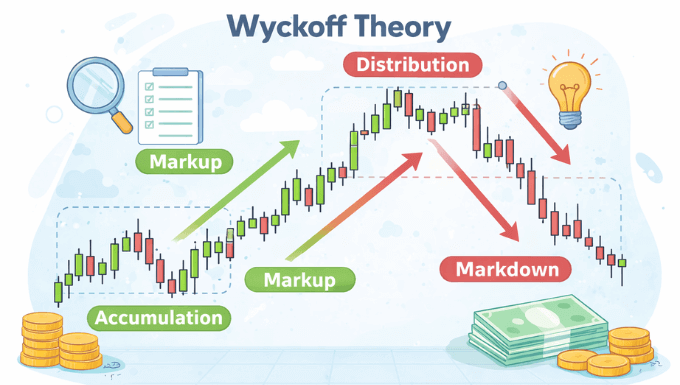
Wyckoff Theory is a time-tested market framework that explains how prices move based on supply, demand, and the behavior of large institutional players. Rather than relying on indicators alone, Wyckoff Theory focuses on reading price action to understand who is in control of the market and why the price is moving.
Developed in the early 20th century, this method remains highly relevant today because markets still operate on the same core principles of human behavior, liquidity, and imbalance. When applied correctly, Wyckoff Theory helps traders align with dominant market forces instead of fighting them.
The Origins and Philosophy Behind Wyckoff Theory
Wyckoff Theory is built on the belief that markets are driven by professionals with significant capital. These participants accumulate and distribute positions strategically, leaving visible clues on the price chart.
Richard Wyckoff studied stock market operators and identified repeating patterns in price behavior. His goal was to help individual traders understand how large players operate so they could trade alongside them rather than react emotionally to price swings.
The Core Idea of Wyckoff Theory
At its core, Wyckoff Theory explains how price moves through structured phases as large players build, test, and release positions. These phases occur because institutions cannot enter or exit trades instantly without moving the market.
The price does not move randomly. Instead, it follows a logical sequence that reflects preparation, execution, and profit-taking by informed participants.
The Three Fundamental Laws of Wyckoff Theory
Wyckoff Theory is based on three foundational laws that explain price behavior in all markets and time frames.
The Law of Supply and Demand
This law states that price rises when demand exceeds supply and falls when supply exceeds demand. While this may sound simple, Wyckoff focuses on how this imbalance develops, not just when price moves.
By observing volume and price spread together, traders can identify whether buyers or sellers are truly in control.
The Law of Cause and Effect
This law explains that price moves are the result of prior preparation. Accumulation or distribution creates the “cause,” while the subsequent markup or markdown is the “effect.”
The longer and more structured the preparation phase, the more meaningful the resulting price move tends to be.
The Law of Effort vs Result
This law compares effort (volume) to result (price movement). When large volume produces little price progress, it often signals absorption or exhaustion.
Such mismatches provide early warnings of potential reversals or trend slowdowns.
The Four Market Phases in Wyckoff Theory
Wyckoff Theory divides market behavior into four repeating phases that form a complete price cycle.
Accumulation Phase
The accumulation phase is where large players quietly build long positions after a downtrend. Price usually moves sideways as supply is absorbed without allowing price to rise too early.
This phase often appears confusing to retail traders, which is intentional. The lack of direction discourages participation while institutions prepare for the next move.
Markup Phase
The markup phase begins when demand clearly overcomes supply. Price starts forming higher highs and higher lows, signaling a controlled uptrend.
Breakouts during this phase are supported by expanding volume and strong follow-through, confirming genuine buying interest.
Distribution Phase
The distribution phase occurs after a prolonged uptrend when institutions gradually exit long positions. Price often moves sideways again, but the character of movement changes.
Rallies fail more often, volatility increases, and selling pressure quietly grows beneath the surface.
Markdown Phase
The markdown phase begins when supply overwhelms demand. Price declines rapidly as institutions complete their distribution and retail traders react late.
This phase is typically emotional and fast-moving, creating fear-driven selling and poor decision-making.
Key Events and Structures in Wyckoff Theory
Wyckoff Theory identifies specific events that help traders recognize where the market is within a phase.
Selling Climax and Buying Climax
A selling climax occurs near the end of a downtrend when panic selling is absorbed by strong buyers. A buying climax appears near market tops when aggressive buying meets heavy professional selling.
Both events are marked by high volume and emotional price behavior.
Springs and Upthrusts
A spring is a false downside break during accumulation designed to shake out weak holders. An upthrust is the opposite—a false upside break during distribution meant to trap late buyers.
These moves are deliberate liquidity events rather than genuine breakouts.
Tests and Confirmations
Tests occur when price revisits key levels to check whether supply or demand remains present. Successful tests show reduced volume and limited price movement, confirming control by dominant players.
These moments often provide the lowest-risk trade opportunities.
How to Trade Using Wyckoff Theory
Wyckoff Theory is not a mechanical system. It requires observation, patience, and context-based decision-making.
Effective Wyckoff traders focus on:
- Identifying the current market phase
- Reading volume in relation to price movement
- Waiting for confirmation rather than prediction
Trades are taken only when price behavior aligns with the underlying narrative of accumulation or distribution.
Common Mistakes When Using Wyckoff Theory
Many traders struggle with Wyckoff Theory because they attempt to oversimplify it. Labeling every range as accumulation or distribution without confirmation leads to poor results.
Another common mistake is ignoring the broader market structure. Wyckoff analysis works best when combined with trend context and higher-timeframe direction.
Wyckoff Theory vs Indicators
Wyckoff Theory differs from indicator-based strategies because it prioritizes cause and intention rather than mathematical outputs. Indicators react to price, while Wyckoff analysis interprets price behavior directly.
This does not mean indicators are useless, but they should support analysis—not replace it.
Why Wyckoff Theory Still Works in Modern Markets
Despite advances in technology and algorithmic trading, markets are still driven by liquidity, positioning, and human psychology. Institutions still need time to build and exit positions, and those actions still leave footprints.
Wyckoff Theory remains effective because it focuses on how markets operate, not on temporary tools or trends.
Who Should Learn Wyckoff Theory
Wyckoff Theory is ideal for traders who want to understand market logic rather than chase signals. It suits swing traders, position traders, and even long-term investors who value structure and context.
While it requires study and patience, the depth of understanding it provides can significantly improve decision-making.
Final Thoughts on Wyckoff Theory
Wyckoff Theory offers a powerful framework for understanding price action, market phases, and institutional behavior. It teaches traders to observe rather than react, and to wait for clarity instead of forcing trades.
When practiced with discipline and realistic expectations, Wyckoff Theory can transform how traders see the market from chaos into structured opportunity.

Vincent Nyagaka has been trading and analyzing markets for over 10+ years. He is a respected trader, author, and coach in financial markets, and is known as the authority on price action trading. At Eazypips, he shares practical strategies and trading lessons to guide aspiring traders toward consistent results.