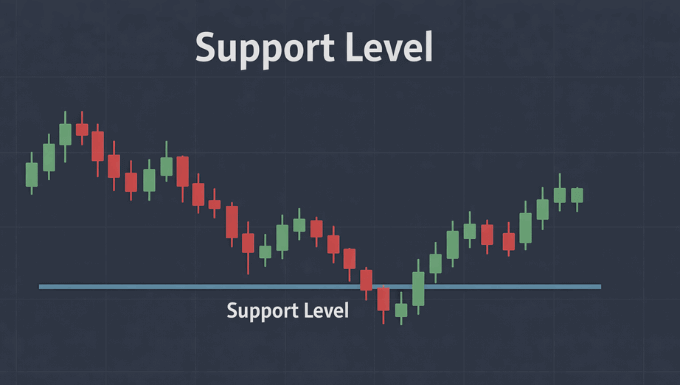
A support level is one of the most essential concepts in technical analysis and plays a central role in trading. It represents a price area where an asset often stops falling and begins to stabilize or reverse due to increased buying interest. Traders rely on support levels to anticipate potential turning points, improve trade timing, and control risk more effectively.
In fast-moving markets, prices rarely move in a straight line. Instead, they rise and fall in waves. Support levels help traders make sense of these movements by highlighting areas where demand has historically been strong. Understanding how support forms and how price reacts around them is a foundational skill for anyone serious about trading.
Click Here To Join our Telegram Community
What Is a Support Level?
A support level is a price zone where downward price movement tends to slow down or stop because buying pressure becomes stronger than selling pressure. This zone often acts as a temporary “floor,” preventing the price from falling further unless selling momentum increases significantly.
Support levels are not random. They develop as a result of market psychology. When many traders view a price as attractive or undervalued, they are more willing to buy at that level. As buy orders accumulate, selling pressure is absorbed, causing prices to pause or rebound. Over time, this repeated behavior creates a visible reference point on the chart that traders can analyze and use for decision-making.
Why Support Levels Matter in Trading
Support levels matter because they provide structure to price action and help traders make informed, disciplined decisions rather than emotional ones. They offer insight into where demand has historically entered the market and where it may appear again.
Before learning how to draw or trade support, it is important to understand the practical value these levels offer.
Predicting Potential Price Reversals
Support levels often signal areas where a downtrend may weaken. When the price approaches support and begins to slow, it suggests that sellers are losing control. A bounce from support is commonly interpreted as a sign that buyers are stepping back into the market.
Identifying Lower-Risk Entry Points
Buying near support can offer a more favorable risk-to-reward setup. Since invalidation is clear if support breaks, traders can define risk more precisely compared to entering trades randomly.
Assisting With Stop-Loss and Take-Profit Placement
Support levels help traders place logical stop-loss orders just below the support zone. They also help identify realistic take-profit targets when trading rebounds or range-bound markets.
Revealing Market Psychology
Support reflects collective belief about fair value. When price respects support, confidence remains intact. When support fails, it often signals a shift in sentiment, leading to stronger directional moves.
How Support Levels Form in the Market
Support levels form through repeated interactions between buyers and sellers. When the price declines into an area where buyers previously stepped in, many market participants expect a similar reaction. This expectation alone can increase buying interest.
Institutional traders, retail traders, and algorithms all contribute to this behavior. As a result, support is reinforced not by one participant but by the combined actions of the market. The more times the price reacts from a zone, the more visible and respected that support level becomes.
How to Identify a Support Level on a Chart
Identifying support levels requires observing price behavior over time rather than relying on a single indicator. While there are multiple techniques available, the most reliable support zones are often obvious once traders learn what to look for.
Historical Price Lows
Previous swing lows frequently act as support. When the price reaches the same low multiple times and fails to break lower, it creates a strong support zone. The more touches a level has, the more significant it usually becomes.
Trendline Support
In an uptrend, support often forms along a rising trendline. Each pullback finds buyers at progressively higher prices, creating dynamic support that moves with the trend.
Moving Averages as Support
Widely followed moving averages, such as the 50-period or 200-period, often act as support. When price retraces toward these averages and reacts upward, it confirms their role as dynamic support.
Fibonacci Retracement Levels
Fibonacci retracement levels, particularly 38.2%, 50%, and 61.8%, often align with support zones. These levels work best when combined with other forms of support rather than used in isolation.
High-Volume Price Areas
Areas where heavy trading activity occurred in the past often become support zones. High volume indicates strong interest, making these areas more likely to attract buyers again.
Types of Support Levels Explained
Not all support levels behave the same way. Understanding the different types helps traders evaluate reliability and adjust their strategies accordingly.
Horizontal Support
Horizontal support forms when the price repeatedly stops at a similar level. It is the most common and easiest type to identify and is widely used across all markets and timeframes.
Trendline Support
Trendline support develops along an upward-sloping line in trending markets. As long as the price continues to respect the trendline, the uptrend remains valid.
Dynamic Support
Dynamic support changes over time and includes tools such as moving averages and trend channels. These levels adjust as price evolves, making them useful in trending conditions.
Psychological Support
Round numbers such as 1.2000 in Forex or 20,000 in Bitcoin often act as psychological support. Traders naturally place orders around these levels, increasing their significance.
How Traders Use Support Levels in Practice
Support levels are not just theoretical concepts. They are actively used in real trading strategies across Forex and cryptocurrency markets.
Buying the Bounce
Many traders look for buying opportunities when the price approaches support and shows signs of rejection, such as long lower wicks or bullish candlestick patterns.
Confirming Breakdowns
When price breaks below support and closes decisively beneath it, traders may interpret this as confirmation of weakness and look for selling opportunities.
Managing Risk Effectively
Support provides a logical reference for defining risk. Traders know exactly where their trade idea becomes invalid, allowing for disciplined stop-loss placement.
Planning Realistic Profit Targets
Support-based reactions help traders set reasonable profit objectives instead of relying on guesswork or emotions.
What Happens When a Support Level Breaks?
No support level lasts forever. When selling pressure becomes strong enough, support can fail. This event often leads to increased volatility and stronger directional movement.
When support breaks, several things typically occur:
- Price may accelerate downward as confidence weakens
- The broken support often turns into resistance
- More sellers enter the market, reinforcing the move
This transition reflects a clear change in market behavior and often marks the beginning of a new trend phase.
Common Mistakes Traders Make With Support Levels
Even though support levels are simple in concept, many traders misuse them. Avoiding common mistakes can significantly improve trading consistency.
Treating Support as a Single Price
Support is usually a zone, not an exact number. Expecting perfect reactions often leads to premature exits or missed trades.
Ignoring Volume and Confirmation
Strong support levels are often supported by noticeable volume or clear price reactions. Ignoring these clues reduces reliability.
Entering Trades Without Evidence
Buying simply because the price touches support is risky. Waiting for confirmation, such as bullish candles, improvesthe probability.
Relying on Support Alone
Support works best when combined with other tools. Using it in isolation can lead to false signals, especially in volatile markets.
How to Strengthen Support Level Analysis
Support levels become far more powerful when used alongside complementary analysis methods. Combining tools helps filter out weak setups and improves accuracy.
Effective techniques include:
- Analyzing multiple timeframes
- Combining support with RSI or MACD
- Studying candlestick behavior near support
- Observing market structure and trend direction
This layered approach provides context and reduces unnecessary risk.
Support Level vs Resistance Level
Support and resistance are closely connected concepts. Support acts as a price floor, while resistance acts as a price ceiling. Together, they define trading ranges, trends, and breakout zones.
When support breaks, it often becomes resistance. Likewise, when resistance breaks, it may turn into support. Understanding this relationship allows traders to adapt quickly as market conditions change.
Frequently Asked Questions About Support Levels
Yes. The concept of support applies equally to Forex, cryptocurrency, stocks, and commodities. Only volatility and timeframes differ.
There is no fixed number, but multiple clean reactions generally strengthen a support zone.
Yes. Support is not guaranteed. That is why risk management and confirmation are essential.
Support levels are an excellent starting point, but beginners should gradually combine them with trend analysis and risk management techniques.
Final Thoughts
A support level is a foundational concept in technical analysis that helps traders understand price behavior, identify potential entry points, and manage risk with greater precision. It reflects collective market psychology and highlights where demand has historically been strong.
When used correctly, support levels provide clarity in uncertain markets and help traders make structured, confident decisions. By learning how to identify, confirm, and combine support levels with other tools, traders can significantly improve their trading performance in both Forex and cryptocurrency markets.