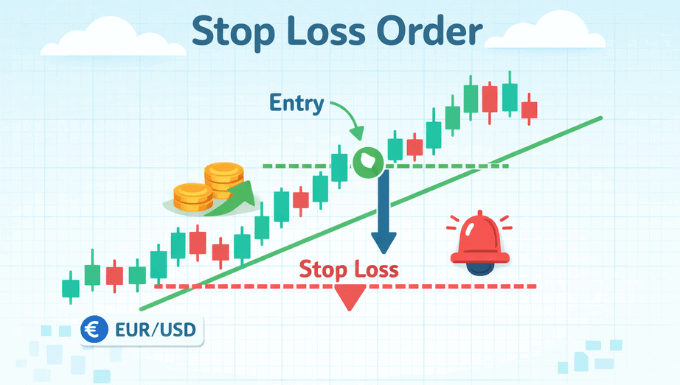
A stop loss order is one of the most important tools for managing risk in trading and investing. It helps you define, in advance, how much you are willing to lose on a trade and automatically exits the position if the market moves against you. This simple mechanism protects your capital, removes emotional decision-making, and brings structure to your trading approach.
Whether you trade forex, stocks, indices, or cryptocurrencies, understanding how a stop loss order works is essential. Used correctly, it does not guarantee profits, but it ensures that losses remain controlled and predictable.
What Is a Stop Loss Order?
A stop loss order is an instruction given to a broker to close a trade automatically when the price reaches a specific level. That level is set at a point where the trader accepts that the trade idea is no longer valid.
The core purpose of a stop loss order is protection rather than profit. It acts as a safety net, limiting downside risk and preventing a small loss from turning into a large one. Without it, traders rely on manual exits, which often fail during fast-moving or emotional market conditions.
How a Stop Loss Order Works
A stop loss order works by monitoring price movement in real time and triggering an exit when the stop price is reached. Once activated, the position is closed according to the order type supported by the trading platform.
For a buy trade, the stop loss is placed below the entry price. If the price falls to that level, the position closes automatically. For a sell trade, the stop loss is placed above the entry price and closes the position if price rises against the trade.
This automation is especially valuable during volatile markets, news releases, or times when you are away from the screen. The trade is managed even when you are not actively watching it.
Why Stop Loss Orders Matter in Trading
Stop loss orders play a critical role in long-term trading survival. They help traders stay disciplined and protect their accounts from catastrophic losses.
Markets can move unpredictably, and even the best analysis can fail. A stop loss order accepts this reality and prepares for it in advance. Over time, consistent risk control matters more than any single winning trade.
Types of Stop Loss Orders
Different stop loss orders exist to suit different trading styles and market conditions. Understanding each type allows you to choose the one that fits your strategy.
Fixed Stop Loss
A fixed stop loss is placed at a specific price level and does not change unless manually adjusted. It is commonly used by beginners because of its simplicity and clarity.
This type works well when your trade setup has a clear invalidation point. However, it does not adapt to changing market conditions or volatility.
Percentage-Based Stop Loss
A percentage-based stop loss limits risk by defining a maximum percentage of capital you are willing to lose on a trade. The stop price is calculated based on that percentage.
This approach keeps risk consistent across trades and accounts of different sizes. It is often used in portfolio and position management strategies.
Trailing Stop Loss
A trailing stop loss moves automatically as the market moves in your favor. When price advances, the stop loss follows at a fixed distance, locking in profits while still allowing room for price movement.
This type is useful in trending markets. It helps traders stay in winning trades longer without manually adjusting stops.
Volatility-Based Stop Loss
A volatility-based stop loss adjusts its distance based on market volatility, often using indicators like the Average True Range (ATR). The stop is placed far enough to avoid normal price noise.
This method is popular among experienced traders who want stops that adapt to changing market conditions rather than fixed distances.
Stop Loss Order vs Stop Limit Order
A stop loss order and a stop limit order are often confused, but they behave differently when triggered. Understanding this difference is important, especially in fast markets.
A stop loss order closes the trade at the best available price once triggered. This ensures execution but may result in slippage during high volatility. A stop limit order, on the other hand, only executes within a specified price range, which can prevent bad fills but risks not closing the trade at all.
For most retail traders focused on risk protection, a standard stop loss order is usually the safer choice.
How to Place a Stop Loss Order Correctly
Placing a stop loss order correctly requires more than choosing an arbitrary distance. It should be based on logic, market structure, and risk tolerance.
A good stop loss is placed at a price level where your original trade idea is proven wrong. This might be below a support level for buy trades or above a resistance level for sell trades. Random stops placed too close to the entry often get hit unnecessarily.
Position size should always be adjusted so that the stop loss distance aligns with your risk rules. A wider stop requires a smaller position, while a tighter stop allows a larger position without increasing risk.
Common Stop Loss Placement Strategies
Traders use different methods to place stop losses depending on their approach and timeframe. Each strategy has strengths and weaknesses.
Some common approaches include:
- Placing stops below recent support or above resistance
- Using recent swing highs or lows
- Setting stops based on technical indicators
- Using fixed risk-to-reward ratios
The key is consistency. Changing stop loss logic randomly from trade to trade often leads to inconsistent results.
Advantages of Using a Stop Loss Order
Stop loss orders provide several important benefits that go beyond simple loss limitation. They improve both performance and discipline over time.
They remove emotional decision-making during losing trades. They allow traders to plan risk before entering a position. They also protect accounts during unexpected news events or sudden market moves.
Most importantly, they make long-term trading sustainable by preventing a few bad trades from wiping out months of progress.
Limitations and Risks of Stop Loss Orders
While stop loss orders are essential, they are not perfect. Traders should understand their limitations to use them realistically.
In fast-moving or illiquid markets, stop loss orders can experience slippage. This means the trade closes at a worse price than expected. Stops can also be triggered by short-term price spikes, especially when placed too close to entry.
These risks do not mean stop losses should be avoided. Instead, they highlight the importance of proper placement and realistic expectations.
Psychological Benefits of Using Stop Loss Orders
Stop loss orders also play a major role in trading psychology. They reduce stress by defining risk clearly before entering a trade.
When losses are planned and accepted in advance, traders are less likely to panic, hesitate, or revenge trade. This clarity improves decision-making and helps maintain confidence during losing streaks.
Over time, traders who consistently use stop losses develop stronger discipline and emotional control.
Stop Loss Orders in Different Markets
Stop loss orders work across most financial markets, but their behavior can vary slightly depending on the asset traded.
In forex, stop losses are widely used and generally executed efficiently due to high liquidity. In stocks, gaps can occur during market openings, which may result in slippage. In cryptocurrencies, volatility can be extreme, making wider stops and smaller position sizes more appropriate.
Understanding market-specific behavior helps you adjust stop loss strategies accordingly.
Common Stop Loss Mistakes to Avoid
Many traders use stop loss orders, but still struggle due to avoidable mistakes. Recognizing these errors can significantly improve results.
Placing stops too close to entry is a common issue, often driven by fear of losing. Moving stop losses further away after price moves against the trade is another serious mistake that increases risk. Ignoring market structure and volatility also leads to poorly placed stops.
A stop loss should protect you, not give false comfort or justify bad trades.
Stop Loss Order and Risk Management
A stop loss order is most effective when used as part of a complete risk management plan. On its own, it limits losses, but combined with proper position sizing, it becomes a powerful tool.
Risking a small, consistent percentage of capital per trade allows traders to survive losing streaks and stay in the game long enough to benefit from winning periods. The stop loss defines the exit, while position size defines how much is at risk.
This combination forms the foundation of professional trading.
Final Thoughts
A stop loss order is not a sign of weakness or lack of confidence. It is a sign of discipline, planning, and respect for market uncertainty. Every successful trader accepts that losses are part of the process and plans for them in advance.
When used correctly, a stop loss order protects your capital, supports emotional control, and creates consistency in your trading decisions. Over the long run, it is one of the most important tools you can use to trade responsibly and sustainably.