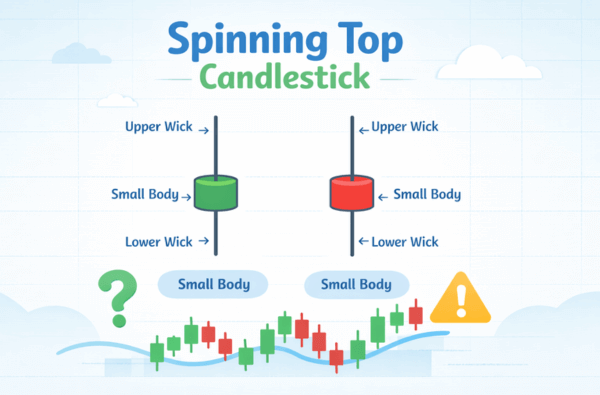
The spinning top candlestick is a classic price-action pattern that signals market indecision. It appears when buyers and sellers fight for control during a trading session, but neither side manages to dominate by the close. Because of this balance, the pattern often warns traders that momentum is slowing and a pause or reversal may be near.
This candlestick is widely used in forex, stocks, commodities, and crypto markets. It does not predict direction on its own, but it provides valuable context when combined with trend analysis, support and resistance, and confirmation signals.
Click here to connect with us on Telegram
What Is a Spinning Top Candlestick?
A spinning top candlestick represents a period where price moves actively in both directions but closes near its opening level. This price behavior shows uncertainty, hesitation, or equilibrium between bullish and bearish forces.
Traders pay attention to this pattern because markets rarely stay undecided for long. After a spinning top forms, price often makes a clearer move once one side gains control.
Key Characteristics of a Spinning Top Candlestick
To understand this pattern properly, it helps to break down its visual structure. Each part of the candlestick reflects trader behavior during that session.
A spinning top typically has:
- A small real body, showing little difference between the open and close
- Upper and lower wicks, indicating price tested both higher and lower levels
- A balanced appearance, suggesting no strong directional bias
The color of the body can be bullish or bearish. What matters most is the size of the body relative to the wicks, not whether it closes green or red.
Psychology Behind the Spinning Top Pattern
Market psychology is the real story behind every candlestick pattern. The spinning top reveals a tug-of-war where neither buyers nor sellers feel confident enough to push price decisively.
Buyers may attempt to continue a move higher, only to face selling pressure. Sellers may try to drive prices lower, but buying interest absorbs the decline. By the close, both sides step back, leaving price near where it started.
This hesitation often appears after strong moves, when traders begin to take profits or reassess risk.
Spinning Top vs Doji Candlestick
Many traders confuse spinning tops with doji candles because both signal indecision. While they are similar, there are important differences.
A doji forms when the open and close are almost exactly the same, resulting in an extremely thin or invisible body. A spinning top still has a visible body, even though it is small.
In practice, spinning tops suggest moderate indecision, while dojis reflect stronger uncertainty. Both require confirmation, but dojis tend to attract more attention due to their precision.
Bullish and Bearish Spinning Tops
A spinning top does not automatically mean bullish or bearish. Its meaning depends heavily on where it appears within the broader trend.
Spinning Top in an Uptrend
When a spinning top forms after a sustained upward move, it often signals that buying momentum is weakening. Traders may be taking profits, and new buyers may hesitate at higher prices.
In this context, the pattern can act as an early warning of a potential pullback or trend reversal, especially near resistance levels.
Spinning Top in a Downtrend
When a spinning top appears after a strong decline, it suggests selling pressure is losing strength. Sellers may be exhausted, while buyers start stepping in cautiously.
This scenario can precede a bounce or reversal, particularly if the candle forms near a key support zone.
Importance of Location in the Chart
The spinning top candlestick becomes meaningful only when viewed in context. Its location on the chart often matters more than the candle itself.
Spinning tops are more reliable when they form:
- Near support or resistance levels
- At trendlines or moving averages
- After strong directional moves
When the pattern appears randomly in sideways markets, it usually carries little predictive value.
How Traders Use the Spinning Top Candlestick
Experienced traders treat the spinning top as a warning sign, not a trading signal on its own. It encourages patience and careful confirmation before entering a trade.
Common trader responses include:
- Waiting for the next candle to confirm direction
- Reducing position size or tightening stop losses
- Preparing for either a breakout or reversal scenario
This cautious approach helps avoid false entries based on indecision alone.
Confirmation Signals to Watch For
Because spinning tops signal uncertainty, confirmation is essential. Traders look for clear follow-up behavior before acting.
Useful confirmation tools include:
- Strong bullish or bearish candles after the spinning top
- Volume expansion, showing renewed conviction
- Technical indicators like RSI, MACD, or moving averages aligning with the move
Without confirmation, acting on a spinning top can lead to unnecessary losses.
Spinning Top Candlestick in Forex Trading
In forex markets, spinning tops frequently appear during session overlaps or before major economic news. These periods often bring uncertainty as traders wait for new information.
Forex traders often use spinning tops to:
- Avoid entering trades before high-impact news
- Identify possible trend exhaustion on higher timeframes
- Fine-tune entries using lower-timeframe confirmation
The pattern works best when combined with clean price-action levels rather than used in isolation.
Spinning Top Candlestick in Stock and Crypto Markets
In stocks and cryptocurrencies, spinning tops often form near earnings releases, regulatory news, or major sentiment shifts. These events increase volatility but also uncertainty.
In crypto markets especially, spinning tops can appear frequently due to rapid sentiment changes. Traders usually rely on higher-timeframe analysis to filter out noise and avoid overreacting to single candles.
Common Mistakes When Trading Spinning Tops
Many traders misuse this pattern by expecting it to predict exact reversals. This misunderstanding leads to premature entries and frustration.
Common mistakes include:
- Trading the spinning top without confirmation
- Ignoring the overall trend
- Overusing the pattern in choppy, sideways markets
Recognizing these pitfalls helps traders use the pattern more effectively and realistically.
Advantages and Limitations of the Spinning Top Candlestick
Every technical pattern has strengths and weaknesses. Understanding both builds trust and consistency in trading decisions.
Advantages
- Easy to identify visually
- Useful for spotting momentum loss
- Works across multiple markets and timeframes
Limitations
- Does not provide direction alone
- Requires confirmation to be reliable
- Less effective in low-volume or ranging markets
Using the pattern as part of a broader strategy improves its value significantly.
Final Thoughts
The spinning top candlestick is a powerful visual clue that the market is undecided. It reflects a pause in momentum where traders reassess direction, risk, and conviction.
When used with proper context, confirmation, and discipline, this pattern helps traders avoid impulsive decisions and prepare for the next meaningful move. Instead of predicting the future, the spinning top teaches patience—an essential skill for long-term trading success.
 Join Our Telegram Channel