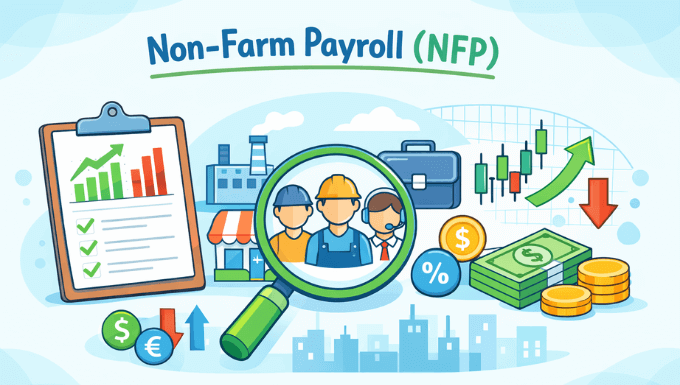
Non-Farm Payroll (NFP) is one of the most closely watched economic indicators in the world because it reflects the overall health of the U.S. labor market. It measures the total number of paid workers in the United States, excluding farm employees, government workers, private household employees, and non-profit organization staff.
This report is published monthly by the U.S. Bureau of Labor Statistics (BLS) and provides a snapshot of how many jobs were added or lost during the previous month. Because employment growth is closely tied to consumer spending, inflation, and economic stability, the NFP report plays a major role in financial markets and policy decisions.
Why Non-Farm Payroll Is So Important
The importance of Non-Farm Payroll lies in its ability to reflect real economic activity rather than predictions or sentiment. Employment levels directly influence income, consumer confidence, and overall economic momentum.
For traders, investors, and policymakers, NFP serves as an early indicator of economic expansion or slowdown. Strong job growth usually signals a healthy economy, while weak or negative figures can raise concerns about recession or stagnation.
What Jobs Are Included and Excluded in NFP
To understand the NFP report correctly, it helps to know which workers are counted and which are not. The data focuses on sectors that best represent ongoing economic activity.
Jobs Included in Non-Farm Payroll
- Manufacturing and industrial workers
- Construction employees
- Retail and wholesale trade workers
- Healthcare and education employees
- Financial services and professional services
Jobs Excluded from Non-Farm Payroll
- Agricultural workers
- Self-employed individuals
- Private household employees
- Military and government workers
These exclusions exist because employment in those areas can be seasonal, volatile, or difficult to measure consistently.
How the Non-Farm Payroll Report Is Calculated
The NFP figure is compiled through two major surveys conducted by the U.S. Bureau of Labor Statistics. Each survey provides a different perspective on the labor market.
The Establishment Survey collects data from businesses and government agencies to measure job creation. The Household Survey focuses on individuals and helps determine the unemployment rate, labor force participation, and employment trends.
By combining insights from both surveys, analysts gain a broader and more accurate picture of labor market conditions.
When the Non-Farm Payroll Report Is Released
The Non-Farm Payroll report is released on the first Friday of every month, usually at 8:30 a.m. Eastern Time. Because the timing is predictable, financial markets often prepare for heightened volatility ahead of the release.
Traders closely monitor this event because even small deviations from expectations can trigger sharp price movements across currencies, stocks, and commodities.
How Non-Farm Payroll Affects Financial Markets
The NFP report influences nearly every major financial market because it shapes expectations about economic growth and central bank policy.
Impact on the Forex Market
Currency markets react strongly to NFP data, especially pairs involving the U.S. dollar. Strong job growth typically strengthens the dollar, while weaker-than-expected numbers can cause it to fall.
Impact on Stock Markets
Stock markets may react positively to moderate job growth, which signals economic stability. However, extremely strong numbers can sometimes pressure stocks if investors expect interest rate hikes.
Impact on Bonds and Interest Rates
Bond yields often rise when job growth exceeds expectations, as investors anticipate tighter monetary policy. Conversely, weaker data can push yields lower.
Why Traders Pay Close Attention to NFP Data
Traders closely follow the Non-Farm Payroll report because it often leads to high volatility and trading opportunities. Price movements during NFP releases can be sharp and fast, especially in major currency pairs like EUR/USD, GBP/USD, and USD/JPY.
For experienced traders, this volatility can create opportunities. For beginners, it can increase risk, making risk management and preparation essential.
How Traders Prepare for the Non-Farm Payroll Release
Preparation is essential when trading around NFP data. Many traders adjust their strategies to account for potential volatility and unexpected outcomes.
Common preparation steps include:
- Reviewing previous NFP results and market reactions
- Monitoring employment forecasts and analyst expectations
- Reducing position sizes or tightening risk controls
- Avoiding overleveraging during the release window
Being prepared helps traders manage risk rather than reacting emotionally to sudden price movements.
Common Misconceptions About Non-Farm Payroll
One common misunderstanding is that a strong NFP number always leads to market gains. In reality, markets respond to expectations, not just the headline figure.
Another misconception is that NFP reflects the entire economy. While it is influential, it does not capture every sector, which is why traders also follow inflation, wage growth, and participation rates.
How Non-Farm Payroll Fits Into Broader Economic Analysis
Non-Farm Payroll is most powerful when viewed alongside other economic indicators. Inflation data, interest rate decisions, and consumer spending trends all provide context that helps interpret NFP results more accurately.
Professional analysts rarely rely on NFP alone. Instead, they combine it with other data to build a clearer picture of economic strength or weakness.
Final Thoughts
Non-Farm Payroll remains one of the most important economic indicators in global financial markets. Its ability to reflect employment trends, influence central bank decisions, and drive market volatility makes it essential knowledge for traders and investors alike.
Understanding how NFP works, what it measures, and how markets react to it can help you make more informed financial decisions and better manage risk in fast-moving market conditions.