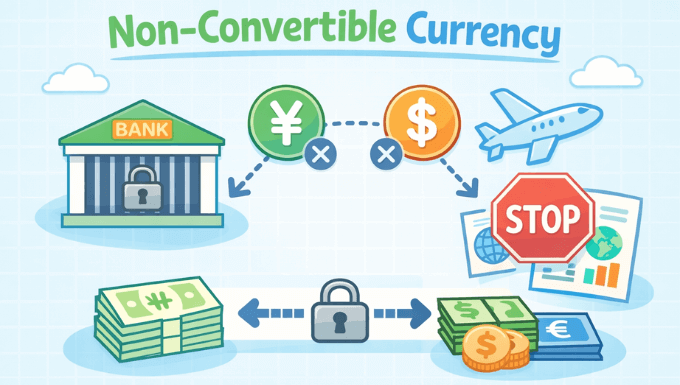
A non-convertible currency is a national currency that cannot be freely exchanged for other foreign currencies on the global foreign exchange market. In the first encounter with the concept of a non-convertible currency, many people assume it is rare or outdated, yet it still plays a major role in several economies today. Governments usually restrict conversion to protect foreign exchange reserves, control capital flows, or manage economic stability.
This type of currency is common in countries that want to closely manage how money moves in and out of their economy. For traders, travelers, and international businesses, non-convertible currencies create practical limitations that affect payments, investments, and exchange processes.
Click here to connect with us on Telegram
What Is a Non-Convertible Currency?
A non-convertible currency is defined by strict government controls that limit or completely prevent its exchange into foreign currencies. These restrictions are usually enforced through central banks or monetary authorities.
Instead of being traded freely on international forex markets, the currency can only be exchanged in limited amounts or through approved channels. This approach allows governments to influence exchange rates and reduce the risk of capital flight during periods of economic stress.
Key Characteristics of a Non-Convertible Currency
Non-convertible currencies share common features that clearly separate them from freely traded currencies. These features shape how the currency functions both domestically and internationally.
Government-Controlled Exchange Rates
The exchange rate is often fixed or tightly managed by the central bank rather than determined by market supply and demand. This allows authorities to stabilize prices but reduces transparency.
Limited Access to Forex Markets
Non-convertible currencies are not actively traded on global forex platforms. Most exchanges occur through official institutions or licensed dealers.
Capital Movement Restrictions
There are strict rules on how much money individuals or businesses can move across borders. These rules apply to investments, savings, and sometimes even trade payments.
Why Some Countries Use Non-Convertible Currencies
Countries adopt non-convertible currencies for strategic economic and political reasons. These decisions are rarely random and often reflect deeper structural challenges.
Protecting Foreign Exchange Reserves
Limiting conversion helps conserve foreign currency reserves, especially in economies that rely heavily on imports. Without controls, reserves could quickly be depleted.
Managing Economic Stability
During inflation, debt crises, or political uncertainty, restrictions reduce sudden capital outflows. This gives governments time to stabilize their financial systems.
Controlling Capital Flight
By restricting currency exchange, authorities prevent investors from rapidly moving funds abroad. This is particularly important in developing or transitioning economies.
Examples of Non-Convertible Currencies
Several countries currently operate with non-convertible or partially convertible currencies. These examples highlight how widespread the system still is.
Chinese Yuan (Renminbi)
The Chinese yuan is partially convertible, meaning it can be exchanged for trade purposes but remains restricted for capital transactions. China uses this model to maintain control over its financial system.
Cuban Peso
The Cuban peso has long faced strict conversion limits, especially for international trade and foreign exchange. These controls reflect broader economic policies.
North Korean Won
The North Korean won is one of the most restricted currencies in the world. It cannot be freely exchanged outside the country under normal circumstances.
Non-Convertible vs Convertible Currency
Understanding the difference between non-convertible and convertible currencies helps clarify their real-world impact. The contrast affects trade, investment, and travel.
Market Freedom
Convertible currencies, such as the US dollar or euro, can be exchanged freely without government approval. Non-convertible currencies require authorization or follow strict limits.
Exchange Rate Transparency
Convertible currencies have transparent, market-driven rates. Non-convertible currencies rely on official rates that may differ from black-market values.
Global Acceptance
Convertible currencies are widely accepted for international payments. Non-convertible currencies are usually only valid within national borders.
Impact on International Trade
Non-convertible currencies directly influence how countries engage in global trade. Businesses must adapt their payment and settlement methods.
Exporters may require payments in foreign currencies such as US dollars or euros. Importers often need government approval to access foreign exchange, which can slow transactions and increase costs.
Impact on Forex Trading
Non-convertible currencies are largely absent from retail forex trading. This absence affects traders seeking diversification or exposure to emerging markets.
Forex brokers rarely offer pairs involving non-convertible currencies due to low liquidity and regulatory barriers. When exposure exists, it is usually indirect through derivatives or offshore instruments.
How Non-Convertible Currencies Affect Travelers
Travelers feel the impact of non-convertible currencies immediately. Exchange options are often limited and regulated.
Visitors may only exchange money at official counters, airports, or banks. Unused currency often cannot be converted back after leaving the country, making careful planning essential.
Advantages of a Non-Convertible Currency
Despite limitations, non-convertible currencies offer certain benefits for governments and policymakers. These advantages explain why the system persists.
- Greater control over monetary policy and exchange rates
- Reduced risk of sudden capital outflows
- Protection against speculative attacks on the currency
These benefits are most valuable during economic instability or external financial shocks.
Disadvantages of a Non-Convertible Currency
The restrictions also create clear downsides that affect growth and investor confidence. These disadvantages often become more visible over time.
Limited foreign investment, reduced trade efficiency, and the growth of black markets are common consequences. Over the long term, these factors can slow economic development.
Black Markets and Parallel Exchange Rates
One common side effect of non-convertible currencies is the emergence of unofficial exchange markets. These markets exist when official rates do not reflect real demand.
Parallel exchange rates often differ significantly from government-set rates. This gap can distort pricing, encourage illegal activity, and reduce trust in official institutions.
Are Non-Convertible Currencies Becoming Obsolete?
While global finance favors open markets, non-convertible currencies are not disappearing. Several countries continue to rely on them as policy tools.
Some economies gradually move toward partial convertibility as stability improves. Others maintain strict controls due to political priorities or structural challenges.
The Future of Non-Convertible Currencies
The future of non-convertible currencies depends on economic reforms, technological change, and global integration. Digital payment systems and regional trade agreements are slowly reshaping currency controls.
Even so, full convertibility requires strong institutions, stable inflation, and deep financial markets. Until those conditions are met, non-convertible currencies will remain a practical reality in parts of the world.
Final Thoughts
A non-convertible currency reflects a country’s choice to prioritize control over openness in its financial system. While it limits flexibility for traders, investors, and travelers, it can provide stability during uncertain times.
Understanding how non-convertible currencies work is essential for anyone involved in international finance, forex trading, or global business. With the right context, these currencies make sense as tools rather than obstacles.
 Join Our Telegram Channel