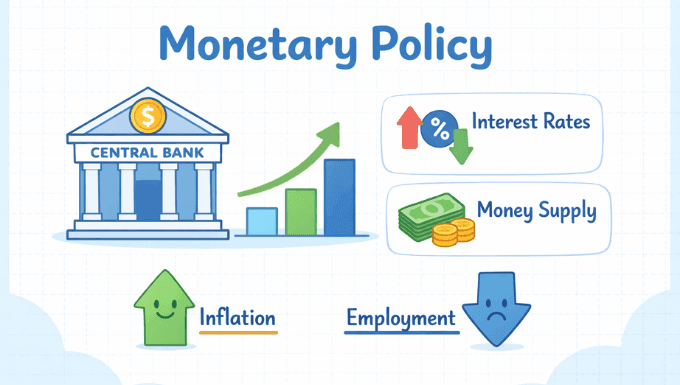
Monetary policy refers to the actions taken by a country’s central bank to manage money supply and credit conditions in the economy. In simple terms, it is how central banks influence interest rates and liquidity to support stable prices, steady growth, and healthy employment.
In the first moments of any economic cycle, monetary policy quietly shapes borrowing costs, savings returns, and overall confidence. When handled well, it smooths booms and cushions downturns. When misunderstood, it can feel distant, even confusing, despite its direct impact on everyday life.
What Monetary Policy Aims to Achieve
At its core, monetary policy is designed to balance economic growth with price stability. Central banks focus on a few clear goals that guide every decision they make.
These objectives are not abstract targets. They directly affect how affordable loans are, how safe savings feel, and how predictable the economy remains over time.
Price Stability and Inflation Control
Price stability means keeping inflation low and predictable rather than letting prices rise too fast or fall sharply. Stable prices help households plan spending and allow businesses to invest with confidence.
When inflation is controlled, money retains its purchasing power. This stability supports long-term economic trust and reduces uncertainty across the financial system.
Supporting Employment and Economic Growth
Another key goal is to support sustainable economic growth that creates jobs without overheating the economy. While central banks do not control employment directly, their policies strongly influence business activity.
Lower borrowing costs can encourage companies to expand and hire, while tighter conditions can prevent unsustainable growth that leads to painful corrections later.
How Monetary Policy Works in Practice
Monetary policy works through a set of tools that influence how money flows through banks, businesses, and households. These tools are adjusted carefully, often gradually, to avoid shocking the economy.
Central banks rely on data, forecasts, and experience to decide when and how strongly to act. Their decisions ripple through financial markets before reaching everyday economic activity.
Interest Rates as the Main Signal
Interest rates are the most visible and widely discussed policy tool. By raising or lowering a benchmark rate, central banks influence how expensive it is to borrow or how attractive it is to save.
Lower rates usually encourage spending and investment, while higher rates slow demand and reduce inflationary pressure. This balance is at the heart of effective monetary policy.
Open Market Operations and Liquidity
Open market operations involve buying or selling government securities to adjust the amount of money circulating in the banking system. These actions help steer short-term interest rates toward the central bank’s target.
By managing liquidity, central banks ensure that financial institutions can operate smoothly without excessive risk or sudden shortages of funds.
Reserve Requirements and Credit Conditions
Reserve requirements determine how much money banks must hold back rather than lend out. Adjusting these requirements can expand or restrict the flow of credit in the economy.
Although used less frequently today, this tool remains part of the broader monetary policy framework, especially in emerging markets.
Types of Monetary Policy Approaches
Monetary policy is not one-size-fits-all. Central banks adjust their stance depending on economic conditions and risks facing the economy.
Each approach reflects a different priority, shaped by inflation trends, growth prospects, and financial stability concerns.
Expansionary Monetary Policy
Expansionary policy is used when economic activity slows or unemployment rises. Central banks lower interest rates or increase liquidity to stimulate spending and investment.
This approach aims to revive demand and restore confidence without triggering excessive inflation.
Contractionary Monetary Policy
Contractionary policy is applied when inflation becomes too high or the economy overheats. Higher interest rates and tighter credit conditions help cool demand.
While this can slow growth in the short term, it protects long-term stability and purchasing power.
The Role of Central Banks in Monetary Policy
Central banks are independent institutions tasked with designing and implementing monetary policy. Their independence helps shield economic decisions from short-term political pressure.
Well-known examples include those in the United States and the, each operating under clear mandates and accountability frameworks.
Monetary Policy and the Financial Markets
Financial markets respond quickly to changes in monetary policy expectations. Even hints of future decisions can move currencies, bonds, and stock prices within minutes.
Investors closely watch central bank statements because policy shifts affect risk appetite, capital flows, and long-term valuations.
Impact on Currencies and Exchange Rates
Interest rate differences between countries influence currency values. Higher rates often attract foreign capital, strengthening the currency, while lower rates can have the opposite effect.
This relationship explains why monetary policy decisions are closely followed in global foreign exchange markets.
Influence on Stocks and Bonds
Lower interest rates tend to support stock markets by reducing borrowing costs and increasing the appeal of future earnings. Bond prices, meanwhile, move inversely to interest rates.
Understanding these links helps investors interpret market reactions to policy announcements.
Monetary Policy Versus Fiscal Policy
Monetary policy is often mentioned alongside fiscal policy, but the two serve different roles. Monetary policy is controlled by central banks, while fiscal policy is managed by governments through spending and taxation.
When coordinated well, these policies reinforce each other. When misaligned, they can reduce effectiveness or create economic tension.
Challenges and Limitations of Monetary Policy
Monetary policy is powerful, but it is not perfect. Its effects take time to work through the economy, and outcomes are not always predictable.
External shocks, such as global crises or supply disruptions, can reduce its effectiveness and force central banks to adapt quickly.
Time Lags and Uncertainty
Policy changes do not affect the economy instantly. It can take months before lower rates translate into higher spending or investment.
This delay makes timing difficult and increases the risk of acting too early or too late.
Risks of Overreliance
Relying too heavily on monetary policy can create asset bubbles or excessive debt. Sustainable economic health often requires support from structural reforms and sound fiscal management.
Why Monetary Policy Matters to Everyday Life
Monetary policy is not just an abstract economic concept. It influences mortgage rates, business loans, savings returns, and even job prospects.
By shaping the financial environment, monetary policy affects how people plan their futures, manage risk, and respond to economic change.
Key Takeaways on Monetary Policy
Monetary policy is a central pillar of modern economic management, guiding inflation, growth, and financial stability. Through interest rates and liquidity tools, central banks influence the rhythm of economic activity.
Understanding how monetary policy works helps individuals, businesses, and investors make more informed decisions in a changing economic landscape.