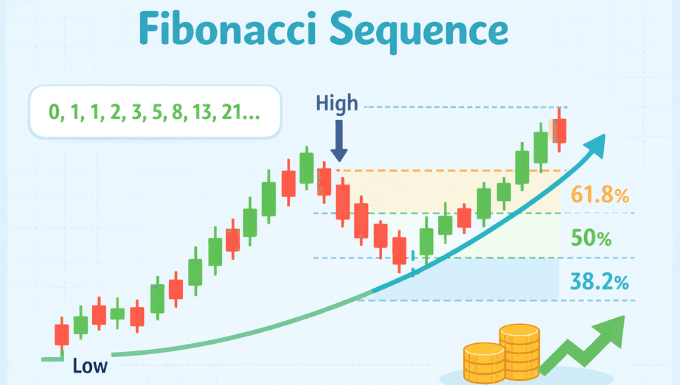
The Fibonacci Sequence is a simple number pattern that appears in mathematics, nature, art, and financial markets. It follows a clear rule where each number is the sum of the two numbers before it, creating a sequence that grows in a predictable way.
This pattern may look basic at first, but it has deep implications. From the structure of flowers to stock market analysis, the Fibonacci Sequence has become one of the most widely referenced numerical concepts in both science and finance.
What Is the Fibonacci Sequence?
The Fibonacci Sequence is a series of numbers that begins with 0 and 1, where each new number is the sum of the two previous numbers. This creates a steadily expanding sequence that follows a consistent mathematical rule.
The sequence typically looks like this:
0, 1, 1, 2, 3, 5, 8, 13, 21, 34, 55, and so on. While the numbers grow larger, the relationship between them stays the same, which is why the sequence is so powerful.
Origin and History of the Fibonacci Sequence
The Fibonacci Sequence was introduced to Western mathematics by Leonardo of Pisa, commonly known as Fibonacci, in the 13th century. He described it in his book Liber Abaci while explaining how a rabbit population might grow over time.
Although Fibonacci helped popularize the sequence in Europe, similar patterns existed earlier in Indian mathematics. What made Fibonacci’s work influential was how clearly the sequence demonstrated natural growth through numbers.
How the Fibonacci Sequence Works
The structure of the Fibonacci Sequence is built on repetition and progression. Each number depends entirely on the two numbers that come before it, which creates a smooth and logical flow.
This dependency means the sequence grows at an increasing rate. Early numbers rise slowly, but later numbers become much larger, showing how simple rules can lead to complex outcomes.
Mathematical Properties of the Fibonacci Sequence
The Fibonacci Sequence has unique mathematical characteristics that make it special. One of the most important is the relationship between consecutive numbers as the sequence grows.
As the numbers increase, the ratio between one number and the previous number gets closer to a constant value known as the golden ratio. This connection is why the sequence appears so often in geometry and design.
The Golden Ratio and Its Connection
The golden ratio is approximately 1.618 and is closely linked to the Fibonacci Sequence. When you divide a Fibonacci number by the one before it, the result approaches this ratio as the sequence continues.
This ratio is often associated with balance and visual harmony. It is used in architecture, art, and design because proportions based on it tend to look naturally pleasing to the human eye.
Fibonacci Sequence in Nature
The Fibonacci Sequence appears repeatedly in natural patterns. These patterns are not exact mathematical copies, but they closely follow Fibonacci relationships.
Examples include:
- The arrangement of leaves on a stem
- The number of petals on many flowers
- Spiral patterns in shells and hurricanes
Nature favors this sequence because it allows efficient growth and optimal use of space.
Fibonacci Sequence in Art and Architecture
Artists and architects have used Fibonacci-based proportions for centuries. These proportions help create a balance and structure that feels natural rather than forced.
Famous works of art and historical buildings often reflect Fibonacci ratios in their dimensions. Even when used subconsciously, these proportions tend to improve visual appeal.
Fibonacci Sequence in Financial Markets
In financial trading, the Fibonacci Sequence is used to analyze price movements. Traders believe markets often move in predictable waves that align with Fibonacci ratios.
These ratios are not magic numbers, but they help traders identify potential support and resistance levels. This is why Fibonacci tools are widely used in technical analysis.
Fibonacci Retracement Explained
Fibonacci retracement levels are derived from key ratios in the Fibonacci Sequence. These levels help traders estimate how far a price might pull back before continuing its trend.
Common retracement levels include 23.6%, 38.2%, 50%, and 61.8%. Traders use them to plan entries, exits, and risk management decisions.
Fibonacci Extension Levels
Fibonacci extensions are used to project possible future price targets. They help traders estimate where a price move may end after breaking past a previous high or low.
These levels are especially useful in trending markets. They provide structured targets instead of relying on guesswork or emotions.
Why the Fibonacci Sequence Is So Widely Used
The Fibonacci Sequence is popular because it combines simplicity with real-world relevance. Its rules are easy to understand, yet its applications are surprisingly broad.
Whether in biology, mathematics, or trading, the sequence offers a framework for understanding growth, proportion, and movement. This versatility is what keeps it relevant across disciplines.
Common Misunderstandings About the Fibonacci Sequence
Many people assume the Fibonacci Sequence predicts outcomes with certainty. In reality, it describes tendencies and patterns rather than guarantees.
In trading, Fibonacci tools should never be used alone. They work best when combined with price action, trend analysis, and proper risk management.
Fibonacci Sequence vs Other Number Patterns
The Fibonacci Sequence differs from simple arithmetic or geometric sequences. Instead of adding or multiplying by a fixed number, it builds on previous values.
This recursive structure is what gives the sequence its natural flow. It mirrors real-world growth more closely than many other numerical patterns.
Practical Ways to Learn and Apply the Fibonacci Sequence
Learning the Fibonacci Sequence becomes easier when you see it in action. Applying it across different fields helps reinforce how and why it works.
You can:
- Practice calculating Fibonacci numbers manually
- Observe natural patterns around you
- Use Fibonacci tools on charts to understand market structure
Final Thoughts
The Fibonacci Sequence is more than a mathematical curiosity. It is a practical pattern that explains growth, balance, and structure across many areas of life.
By understanding how the sequence works and where it applies, you gain a powerful tool for analysis and decision-making. Its lasting relevance proves that simple ideas can have an extraordinary impact.
 Join Our Telegram Channel