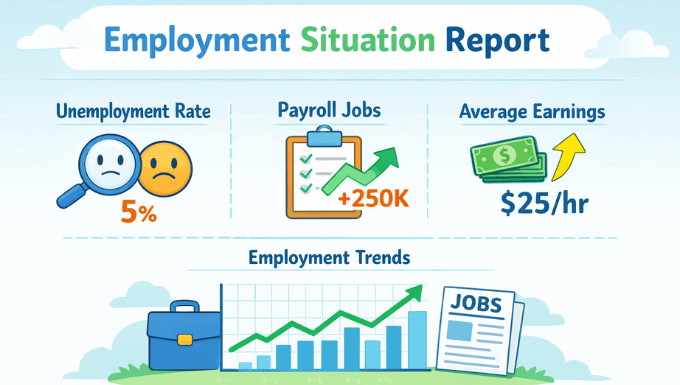
The Employment Situation Report is one of the most closely watched economic releases in the world. Published monthly by the U.S. Bureau of Labor Statistics (BLS), it provides a detailed snapshot of job growth, unemployment, and wage trends across the American economy. For policymakers, investors, businesses, and everyday workers, this report helps explain where the labor market stands and where it may be heading.
Understanding the Employment Situation Report is essential because it influences financial markets, government policy, and even everyday business decisions. This guide breaks down the report in clear, simple language while offering enough depth for readers who want a deeper understanding of its importance.
Understanding Employment Situation Report
The Employment Situation Report is a monthly economic release that summarizes the condition of the U.S. labor market. It combines data from two major surveys conducted by the Bureau of Labor Statistics: the Household Survey and the Establishment Survey.
Together, these surveys measure employment levels, unemployment rates, job creation, wage growth, and labor force participation. Because it provides such a broad view of economic activity, the report is often referred to as the “jobs report” and is one of the most influential economic indicators worldwide.
Why the Employment Situation Report Matters
The Employment Situation Report matters because employment trends reflect the overall health of the economy. When businesses are hiring and wages are rising, it usually signals economic growth. When job losses increase or hiring slows, it may indicate economic weakness or an approaching downturn.
Policymakers, including the Federal Reserve, rely heavily on this report when making decisions about interest rates and monetary policy. Investors also use it to anticipate market movements, while employers use it to assess labor availability and wage pressure.
Who Produces the Employment Situation Report?
The report is published by the U.S. Bureau of Labor Statistics (BLS), an independent federal agency responsible for collecting and analyzing labor market data. The BLS ensures the data is gathered using consistent methods and rigorous statistical standards.
Two separate surveys form the foundation of the report:
- The Household Survey measures employment and unemployment among individuals.
- The Establishment Survey, which tracks payroll employment, hours worked, and earnings across businesses.
Each survey provides different insights, and together they create a complete picture of labor market conditions.
Key Components of the Employment Situation Report
The Employment Situation Report contains several critical data points that analysts and policymakers examine closely. Each component helps explain a different aspect of labor market health.
Nonfarm Payroll Employment
Nonfarm payrolls represent the total number of paid workers in the economy, excluding farm workers, private household employees, and certain government workers. This figure is often the headline number in financial news.
A strong increase in payrolls usually signals economic expansion, while weak or negative growth can indicate slowing activity or recession risks.
Unemployment Rate
The unemployment rate measures the percentage of people in the labor force who are actively seeking work but are unable to find a job. It is one of the most closely watched indicators of economic health.
A low unemployment rate generally reflects strong labor demand, while a rising rate may signal economic stress or job losses.
Labor Force Participation Rate
This metric shows the percentage of the working-age population that is either employed or actively looking for work. It provides context that the unemployment rate alone cannot capture.
A declining participation rate may indicate discouraged workers leaving the labor force, while an increase suggests stronger confidence in job prospects.
Average Hourly Earnings
Average hourly earnings track wage growth across industries. This measure helps assess whether workers are seeing real income gains over time.
Rising wages can boost consumer spending but may also contribute to inflation if growth becomes too rapid.
Average Workweek
The average number of hours worked per week offers insight into labor demand. Employers often adjust working hours before hiring or laying off staff, making this a useful early indicator of economic changes.
How the Employment Situation Report Is Used
The Employment Situation Report influences a wide range of decisions across the economy. Different groups rely on it for different reasons.
Policymakers and Central Banks
Central banks, especially the Federal Reserve, use employment data to guide interest rate decisions. Strong job growth and rising wages may prompt tighter monetary policy, while weak labor data may encourage stimulus measures.
Financial Markets and Investors
Traders and investors closely watch the report because it can move stock prices, bond yields, and currency markets. Unexpected results often lead to market volatility shortly after release.
Businesses and Employers
Companies use the report to assess hiring conditions, wage pressures, and labor availability. It helps businesses plan expansion, recruitment, and compensation strategies.
Workers and Job Seekers
For individuals, the report offers insight into job opportunities, wage trends, and overall labor market strength. It can help guide career decisions and expectations.
When the Employment Situation Report Is Released
The Employment Situation Report is released on the first Friday of every month, typically at 8:30 a.m. Eastern Time. It reflects data from the previous month, making it one of the most timely indicators of economic performance.
Because of its consistency and reliability, it often sets the tone for economic discussions throughout the month.
Common Misunderstandings About the Employment Situation Report
Although widely cited, the report is sometimes misunderstood. One common misconception is that a single month’s data represents a long-term trend. In reality, short-term fluctuations are normal, and trends should be evaluated over several months.
Another misunderstanding is assuming the unemployment rate alone tells the full story. Without considering participation rates, wages, and job quality, conclusions can be misleading.
Limitations of the Employment Situation Report
While highly valuable, the report is not perfect. It relies on surveys, which can be revised as more complete data becomes available. Initial estimates may change in later months.
Additionally, the report does not fully capture informal or gig-based work, which has become more common in modern economies. As a result, some forms of employment may be underrepresented.
Why the Employment Situation Report Still Matters Today
Despite its limitations, the Employment Situation Report remains one of the most trusted and widely used economic indicators. Its consistent methodology and long historical record make it invaluable for analyzing labor market trends over time.
For anyone interested in economics, investing, or public policy, understanding this report provides a clearer picture of how the economy is performing and where it may be headed next.
Final Thoughts
The Employment Situation Report offers a comprehensive view of the U.S. labor market through carefully collected and analyzed data. By understanding its key components and how they interact, readers can better interpret economic news and make informed decisions.
Whether you are a student, investor, policymaker, or simply someone interested in how the economy works, learning how to read and interpret the Employment Situation Report is a valuable skill that pays long-term dividends.