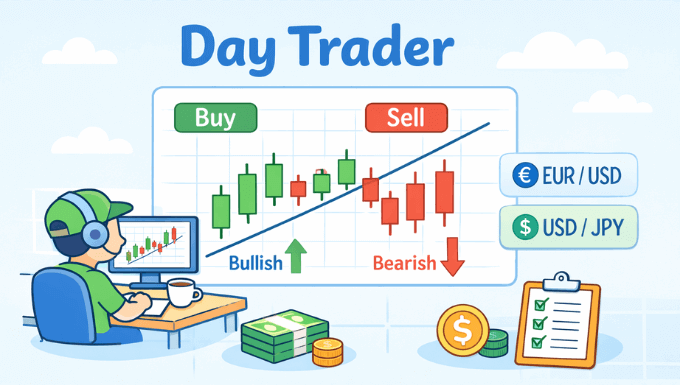
A day trader is an individual who buys and sells financial instruments within the same trading day, aiming to profit from short-term price movements. Unlike long-term investors, a day trader does not hold positions overnight, which reduces exposure to unexpected market events after hours.
In the first minutes and hours of the trading session, a day trader carefully watches price action, volume, and market behavior. The goal is not to predict where the market will be next year, but to identify small, repeatable opportunities that appear during the day.
How Day Trading Works
Day trading works by taking advantage of intraday price fluctuations that occur as markets react to news, economic data, and trader behavior. Prices move constantly during the trading session, creating opportunities for skilled traders to enter and exit quickly.
A typical day trader plans trades in advance, executes them during active market hours, and closes all positions before the market closes. This approach demands focus, discipline, and a clear process, since decisions must be made in real time.
Markets Commonly Used by Day Traders
Different markets attract day traders for different reasons, including liquidity and volatility. Choosing the right market helps align trading style with available opportunities.
- Stocks, especially high-volume shares
- Forex, due to 24-hour access and tight spreads
- Futures are known for leverage and strong price movement
- Cryptocurrencies, which trade continuously and can be highly volatile
Timeframes Used in Day Trading
Day traders rely on short timeframes to make decisions. These charts help them see price movements clearly without unnecessary noise.
Commonly used timeframes include one-minute, five-minute, and fifteen-minute charts. Longer charts may be used for context, but entries and exits are usually based on shorter views.
Key Skills Every Day Trader Needs
Successful day trading is not based on luck. It depends on a specific set of skills that are developed through practice and self-discipline.
A strong day trader learns to manage risk, control emotions, and follow a structured plan. These skills matter more than any single strategy.
Discipline and Emotional Control
Emotions can quickly damage trading results if left unchecked. Fear and greed often cause traders to exit too early or hold losing trades too long.
A disciplined day trader follows predefined rules, even after a losing trade. Consistency in behavior is what allows long-term improvement.
Risk Management
Risk management is the foundation of survival in day trading. Without it, even a few bad trades can wipe out an account.
Most experienced day traders risk only a small percentage of their capital on any single trade. This approach keeps losses manageable and protects the account during drawdowns.
Popular Day Trading Strategies
Day trading strategies provide structure and reduce guesswork. Each strategy is designed to exploit a specific type of market behavior.
No strategy works all the time, so traders choose methods that match their personality and market conditions.
Scalping
Scalping focuses on capturing very small price movements many times a day. Trades may last only seconds or minutes.
This strategy requires fast execution, low transaction costs, and constant attention. It suits traders who enjoy rapid decision-making.
Momentum Trading
Momentum trading aims to profit from strong price moves driven by high volume and news. Traders enter in the direction of the move and exit when momentum slows.
This approach works best during periods of high market activity. Timing and quick reactions are essential.
Range Trading
Range trading is based on identifying price levels where the market repeatedly moves up and down. Traders buy near support and sell near resistance.
This strategy performs well in calm, sideways markets. Clear levels and patience are critical for success.
Tools and Technology Used by Day Traders
Modern-day trading relies heavily on technology. The right tools help traders analyze markets and execute trades efficiently.
While tools do not guarantee success, poor tools can limit performance and increase mistakes.
Trading Platforms
A reliable trading platform provides real-time data, fast order execution, and customizable charts. Stability and speed are especially important for day traders.
Many traders choose platforms that allow one-click trading and advanced order types to manage trades precisely.
Charts and Indicators
Charts are the primary decision-making tool for a day trader. They show price, volume, and historical behavior at a glance.
Indicators such as moving averages or volume-based tools are often used to support decisions. These tools work best when kept simple and well-understood.
Risks and Challenges of Being a Day Trader
Day trading carries significant risk, and it is not suitable for everyone. Losses can occur quickly, especially without proper preparation.
Understanding these challenges helps set realistic expectations and encourages responsible decision-making.
Financial Risk
Short-term trading involves frequent exposure to market volatility. Even experienced traders face losing days and losing streaks.
Capital preservation should always come before profit. Trading with money you cannot afford to lose increases pressure and aleads to nd poor decisions.
Mental and Physical Strain
Day trading requires intense concentration for long periods. Staring at screens and making rapid decisions can be mentally exhausting.
Without breaks and balance, burnout can occur. Many successful traders limit their trading hours to protect focus and well-being.
Day Trader vs Long-Term Investor
Day traders and long-term investors approach markets with very different goals. Understanding the distinction helps clarify which path fits your personality.
A day trader focuses on short-term price movements, while an investor looks at long-term value and growth. Neither approach is better by default, but each requires a different mindset.
How to Start as a Day Trader
Starting as a day trader should be a gradual process, not a rush into live markets. Preparation reduces costly mistakes.
Learning, testing, and self-evaluation are essential before risking real money.
Education and Practice
Begin by learning basic market concepts and trading mechanics. A clear understanding of how orders work is critical.
Practice on a demo account allows you to test strategies without financial risk. This stage builds confidence and highlights weaknesses.
Creating a Trading Plan
A trading plan defines when to trade, how much to risk, and when to stop. It acts as a guide during stressful moments.
A solid plan includes entry rules, exit rules, and daily loss limits. Following the plan is more important than changing it frequently.
Is Day Trading Right for You?
Day trading is demanding, competitive, and emotionally challenging. It suits individuals who enjoy fast-paced decision-making and continuous learning.
Before committing, consider your risk tolerance, available time, and financial situation. For some, day trading becomes a professional pursuit, while for others it remains an educational experience.
Final Thoughts on Becoming a Day Trader
Becoming a day trader is not a shortcut to easy money. It is a skill-based activity that requires patience, discipline, and ongoing self-improvement.
Those who approach day trading with realistic expectations, strong risk management, and a willingness to learn give themselves the best chance of long-term success.