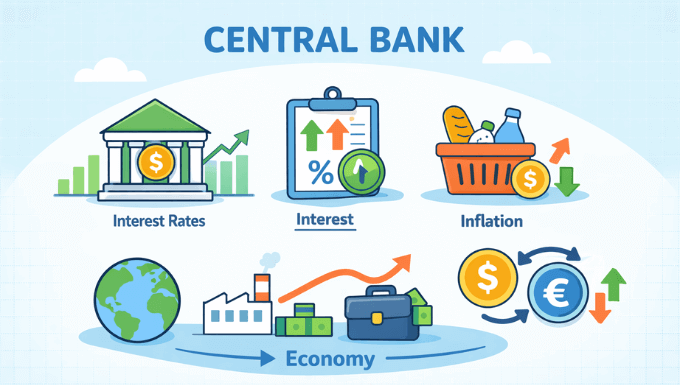
A central bank is the main monetary authority of a country, responsible for managing the money supply, controlling inflation, and maintaining financial stability. Unlike commercial banks, a central bank does not serve the public directly but operates at the core of the financial system to guide economic conditions.
Understanding how a central bank works is essential for anyone interested in economics, investing, or forex trading, because its decisions influence interest rates, currency values, and overall market confidence.
What Is a Central Bank?
A central bank is an independent or semi-independent public institution that oversees a nation’s monetary system. Its primary responsibility is to ensure that money retains its value and that the financial system remains stable.
While the structure and mandate may differ by country, all central banks share the common goal of supporting sustainable economic growth without allowing inflation or financial instability to spiral out of control.
Why Central Banks Exist
Central banks exist to prevent economic chaos caused by an uncontrolled money supply and unstable banking systems. Before central banks became common, financial crises were frequent due to bank failures and unregulated currency issuance.
By acting as a central authority, a central bank provides oversight, credibility, and coordination that individual banks or markets cannot achieve on their own.
Core Functions of a Central Bank
A central bank performs several critical functions that keep the economy functioning smoothly. Each function plays a specific role in balancing growth, stability, and confidence.
Issuing and Managing Currency
One of the most visible roles of a central bank is issuing the national currency. This responsibility ensures that the money supply grows in line with economic needs rather than political or private interests.
By controlling how much money circulates in the economy, the central bank helps prevent excessive inflation or harmful deflation.
Controlling Inflation
Inflation control is a central bank’s most closely watched task. Moderate inflation supports economic growth, but high inflation erodes purchasing power and savings.
Central banks use interest rates and monetary tools to influence spending and borrowing, aiming to keep inflation within a target range.
Managing Interest Rates
Interest rates are one of the strongest tools available to a central bank. When rates rise, borrowing becomes more expensive, slowing economic activity. When rates fall, borrowing and spending usually increase.
These adjustments help smooth out economic cycles rather than eliminate them entirely.
Acting as Lender of Last Resort
During financial stress, banks may struggle to meet short-term obligations. A central bank can step in as a lender of last resort to prevent panic and bank failures from spreading across the system.
This role is critical for maintaining trust in the banking system during crises.
How Central Banks Influence the Economy
Central banks shape economic conditions through policy decisions that affect spending, saving, and investment behavior. Their influence is indirect but powerful.
Changes in central bank policy often ripple through stock markets, bond markets, and currency markets within minutes of being announced.
Monetary Policy
Monetary policy refers to the actions a central bank takes to manage the money supply and credit conditions. These actions are designed to achieve stable prices and sustainable growth.
There are two main types of monetary policy, each used under different economic conditions.
Expansionary Monetary Policy
Expansionary policy is used when the economy is slowing or in recession. The central bank lowers interest rates or injects liquidity to encourage borrowing and spending.
This approach supports growth but must be carefully managed to avoid future inflation.
Contractionary Monetary Policy
Contractionary policy is applied when inflation becomes too high. By raising interest rates or reducing liquidity, the central bank slows demand and cools price increases.
Although effective against inflation, this policy can temporarily slow economic growth.
Central Bank Tools and Instruments
To implement monetary policy, a central bank relies on specific tools. Each tool influences liquidity and credit conditions differently.
Common tools include:
- Policy interest rates, which guide borrowing costs across the economy
- Open market operations, involving the buying or selling of government securities
- Reserve requirements, which determine how much banks must hold in reserve
These tools are adjusted gradually to avoid shocking financial markets.
Independence of a Central Bank
Central bank independence refers to the ability to make decisions without political pressure. This independence is essential for maintaining credibility and long-term economic stability.
When markets trust that a central bank will act objectively, inflation expectations remain stable, and policy becomes more effective.
Central Banks and Financial Stability
Beyond inflation and growth, central banks play a growing role in safeguarding the financial system. This includes monitoring banks, identifying systemic risks, and responding to financial shocks.
After the global financial crisis, many central banks expanded their responsibilities to include stronger oversight of financial institutions.
The Role of Central Banks in Forex Markets
For forex traders, central banks are among the most influential market participants. Interest rate decisions and policy signals often cause significant currency price movements.
Even hints or changes in tone from central bank officials can shift market sentiment and volatility.
Central Bank Communication and Market Expectations
Modern central banks rely heavily on communication to guide expectations. Press conferences, policy statements, and forward guidance help markets understand future policy intentions.
Clear communication reduces uncertainty and prevents sudden market disruptions caused by misunderstandings.
Common Misconceptions About Central Banks
Many people assume central banks control the economy entirely, but their influence has limits. They guide conditions rather than dictate outcomes.
Another misconception is that central banks directly set prices, when in reality they influence demand and credit conditions that affect prices over time.
Central Bank vs Commercial Bank
A central bank differs fundamentally from commercial banks. While commercial banks focus on profit and customer service, a central bank focuses on economic stability.
It does not compete with private banks but instead oversees and supports the broader banking system.
Challenges Faced by Central Banks Today
Modern central banks operate in a complex environment shaped by globalization, digital finance, and rapidly changing markets. Balancing inflation control with economic growth has become more challenging.
Uncertainty, geopolitical risks, and financial innovation require central banks to adapt their tools and strategies continuously.
Why Understanding Central Banks Matters
Understanding the role of a central bank helps individuals make better financial and investment decisions. Interest rates, inflation, and currency values all affect everyday costs and long-term planning.
For traders and investors, central bank actions often define market trends more strongly than any single economic indicator.
Final Thoughts
A central bank is the backbone of a modern financial system, quietly shaping economic conditions through policy, oversight, and credibility. Its decisions influence everything from inflation and employment to currency markets and financial stability.
By understanding how a central bank operates and why its role matters, readers gain valuable insight into the forces that drive economies and global markets.