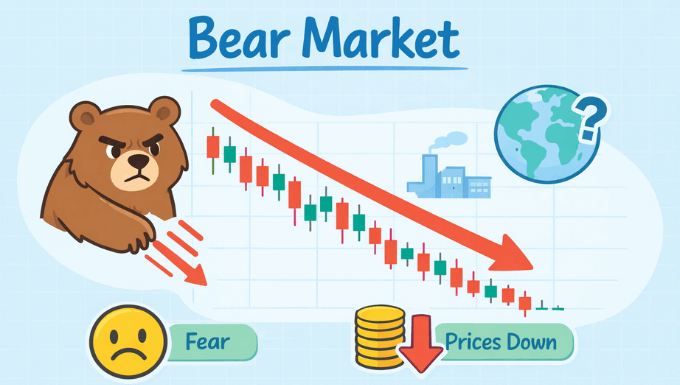
A bear market describes a period when prices in financial markets fall steadily, and investor confidence weakens. The term is most commonly used for stock markets, but it also applies to forex, crypto, commodities, and bonds when prices trend downward for an extended time. Understanding how a bear market works helps traders and long-term investors make calmer, more informed decisions instead of reacting emotionally.
Bear markets are not rare events or signs that markets are broken. They are a normal part of market cycles, often following long periods of growth, and they eventually give way to recovery phases.
What Is a Bear Market?
A bear market is generally defined as a decline of 20% or more from recent highs, sustained over weeks or months. This drop reflects widespread pessimism, lower risk appetite, and selling pressure across the market.
Unlike short-term pullbacks, a bear market is driven by deeper concerns. These concerns may involve the economy, corporate earnings, interest rates, or global uncertainty. Prices fall not because of a single bad day, but because confidence erodes over time.
Why Is It Called a Bear Market?
The phrase “bear market” comes from the way a bear attacks, swiping its paws downward. This downward motion became a metaphor for falling prices and declining trends in financial markets.
The opposite term, bull market, reflects upward movement and optimism. Together, these two terms describe the emotional and directional extremes of market cycles.
Common Causes of a Bear Market
Bear markets rarely appear without warning, and they usually develop from a mix of economic and psychological factors. Understanding these causes helps explain why prices fall and why recoveries take time.
Economic Slowdowns and Recessions
Economic weakness is one of the most common triggers of a bear market. When growth slows, unemployment rises, or consumer spending weakens, companies earn less and investors reassess valuations.
As profits decline or expectations are lowered, investors often sell to reduce risk. This selling pressure pushes prices down across many sectors at the same time.
Rising Interest Rates and Tight Monetary Policy
Higher interest rates increase borrowing costs for businesses and consumers. This often reduces investment, slows expansion, and lowers future earnings expectations.
When central banks tighten policy to fight inflation, markets may react negatively. Stocks and risk assets often struggle during these periods, increasing the chance of a bear market.
Financial Crises and Systemic Shocks
Major financial events can quickly trigger bear markets. Banking crises, credit collapses, or sudden failures of large institutions undermine trust in the financial system.
When fear spreads, investors prioritize safety over returns. This shift leads to broad selling and prolonged downward trends.
Geopolitical and Global Uncertainty
Wars, trade conflicts, pandemics, and political instability can disrupt supply chains and economic activity. Markets dislike uncertainty, and prolonged global tension often weighs heavily on prices.
Even if the direct economic impact is limited, uncertainty alone can reduce investor confidence enough to push markets lower.
Key Characteristics of a Bear Market
A bear market has recognizable features that separate it from short-term corrections. Identifying these traits helps traders and investors adjust expectations realistically.
Prices usually fall over many months rather than days. Volatility increases, with sharp rallies followed by deeper declines. News sentiment becomes mostly negative, and optimism is often viewed with skepticism.
Trading volume may rise during sell-offs as fear-driven decisions dominate. At the same time, many investors step aside, waiting for clearer signs of stability.
How Long Does a Bear Market Last?
There is no fixed timeline for a bear market. Some last only a few months, while others extend over several years, depending on the underlying cause.
Historically, bear markets are shorter than bull markets but feel longer because losses affect emotions more strongly than gains. Recovery often begins before economic data improves, as markets tend to look ahead rather than react to the present.
Bear Market vs Market Correction
A bear market is often confused with a market correction, but the two are different in both depth and duration.
A correction typically involves a decline of 10% to 20% and is usually short-lived. It helps reset valuations without changing the broader trend. A bear market goes further, reflecting deeper structural or economic issues that take longer to resolve.
Investor Psychology During a Bear Market
Emotions play a powerful role during bear markets. Fear, frustration, and doubt often lead to rushed decisions that lock in losses unnecessarily.
Many investors sell near market lows because negative news feels overwhelming. Understanding this psychological pressure helps explain why bear markets often end when sentiment is at its worst.
Strategies for Investors in a Bear Market
While bear markets are challenging, they also reward discipline and patience. A thoughtful approach can reduce damage and sometimes uncover long-term opportunities.
Focus on Risk Management
Protecting capital becomes more important than chasing returns during a bear market. This may involve reducing position sizes, diversifying assets, or holding more cash than usual.
Clear risk limits help prevent emotional decisions when markets move sharply against expectations.
Think Long Term, Not Short Term
For long-term investors, bear markets are part of the journey. Selling quality assets purely out of fear often does more harm than good.
Sticking to a well-defined plan helps maintain perspective. History shows that markets have recovered from every major bear market over time.
Look for Value Carefully
Bear markets often push prices below their long-term value. Strong companies or assets may become undervalued due to broad selling rather than weak fundamentals.
Careful analysis is essential here. Not every low price represents value, but patient research can uncover solid opportunities.
How Traders Approach Bear Markets
Traders often view bear markets differently from long-term investors. Downward trends can offer opportunities, but they also carry higher risk.
Short-selling, trend-following strategies, and defensive setups become more common. Successful traders focus on discipline, clear entries, and strict exit rules to manage volatility.
Are Bear Markets Bad for Everyone?
Although bear markets are uncomfortable, they are not entirely negative. They help remove excess speculation, reset valuations, and restore balance to markets.
For disciplined investors and prepared traders, bear markets can become periods of learning, refinement, and strategic positioning for future growth.
Final Thoughts
A bear market is a natural phase of the financial cycle, not a permanent condition. Prices fall, confidence weakens, and uncertainty dominates, but these periods eventually end.
By understanding what a bear market is, why it happens, and how to respond calmly, investors and traders can avoid costly mistakes. Knowledge, patience, and risk control remain the most reliable tools when markets turn bearish.