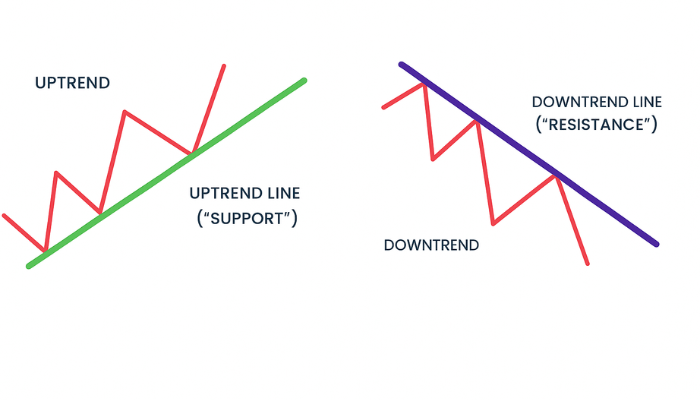
Trend lines are one of the most popular tools in technical analysis. They help traders visually identify the direction of the market by connecting price points on a chart. A properly drawn trend line acts like a “map,” showing whether the market is moving upward, downward, or sideways.
What is a Trend Line?
A trend line is a straight line that connects at least two or more price points, usually swing highs or swing lows, to represent the prevailing direction of the market.
- An uptrend line is drawn by connecting successive higher lows.
- A downtrend line is drawn by connecting successive lower highs.
The more times price touches the trend line without breaking it, the stronger and more reliable that line becomes.
Why Are Trend Lines Important?
Trend lines are valuable because they:
- Show the overall direction of the market (trend).
- Help identify potential support and resistance levels.
- Provide guidance for entry and exit points.
When price touches a trend line and bounces, it often signals a continuation of the trend. If price breaks through the line, it may signal a reversal.
How to Draw Trend Lines Correctly
Many beginners struggle with drawing trend lines because they force lines to fit the market. The correct approach is:
- Identify the main direction of the market (up, down, or sideways).
- For an uptrend, connect at least two higher lows.
- For a downtrend, connect at least two lower highs.
- Adjust the line as new swing highs/lows appear.
Remember: trend lines are not exact; they represent zones where price may react.
Common Mistakes with Trend Lines
- Forcing lines to fit the price action instead of drawing what’s really there.
- Using trend lines on very short timeframes where price noise dominates.
- Ignoring breaks and still relying on a “broken” trend line.
Summary
Trend lines are simple yet powerful tools for spotting market direction and possible reversal zones. When used correctly, they act as visual guides for better trade entries and exits. The key is to draw them objectively and adjust them as the market evolves.