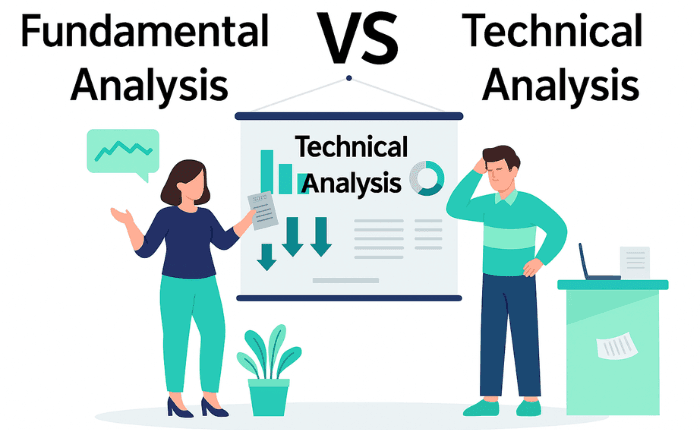
Forex traders employ various types of analysis to inform their trading decisions. The three main approaches are technical analysis, fundamental analysis, and sentiment analysis. Each has its strengths and weaknesses, and many successful traders use a combination of them.
1. Technical Analysis
- Focuses on price charts, patterns, and indicators.
- Assumes that history tends to repeat itself.
- Helps traders identify entry and exit points.
- Works well for short-term trading.
Pros: Quick signals, visual tools.
Cons: May ignore real-world news.
2. Fundamental Analysis
- Studies economic data, interest rates, central bank policies, and news events.
- Helps traders understand the actual value of a currency.
- Works well for long-term trading strategies.
Pros: Deeper understanding of the market.
Cons: Requires constant news monitoring.
3. Sentiment Analysis
- Measures the mood of the market.
- Utilizes tools such as the Commitment of Traders (COT) report or market surveys.
- Helpful in spotting extreme optimism or fear.
Pros: Detects market turning points.
Cons: Harder for beginners to apply.
4. Which is Best?
There is no single “best” method. Instead:
- Day traders often prefer technical analysis.
- Long-term investors lean towards fundamental analysis.
- Sentiment is often used as a confirmation tool.
👉 The best approach is to combine all three types of analysis for a balanced view.